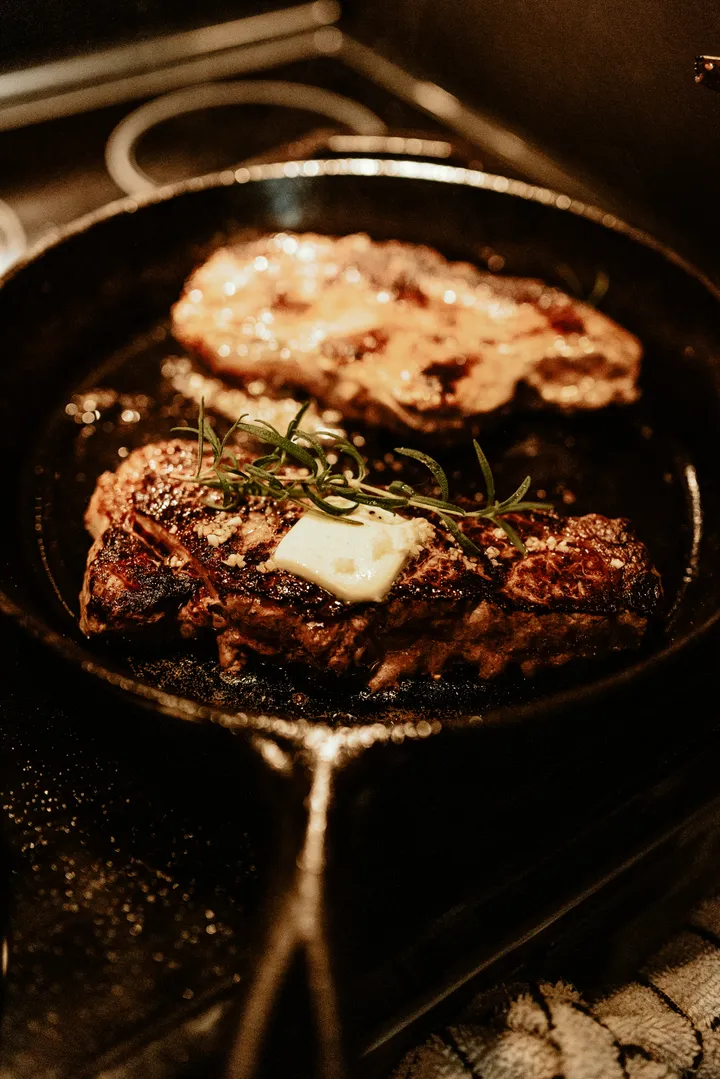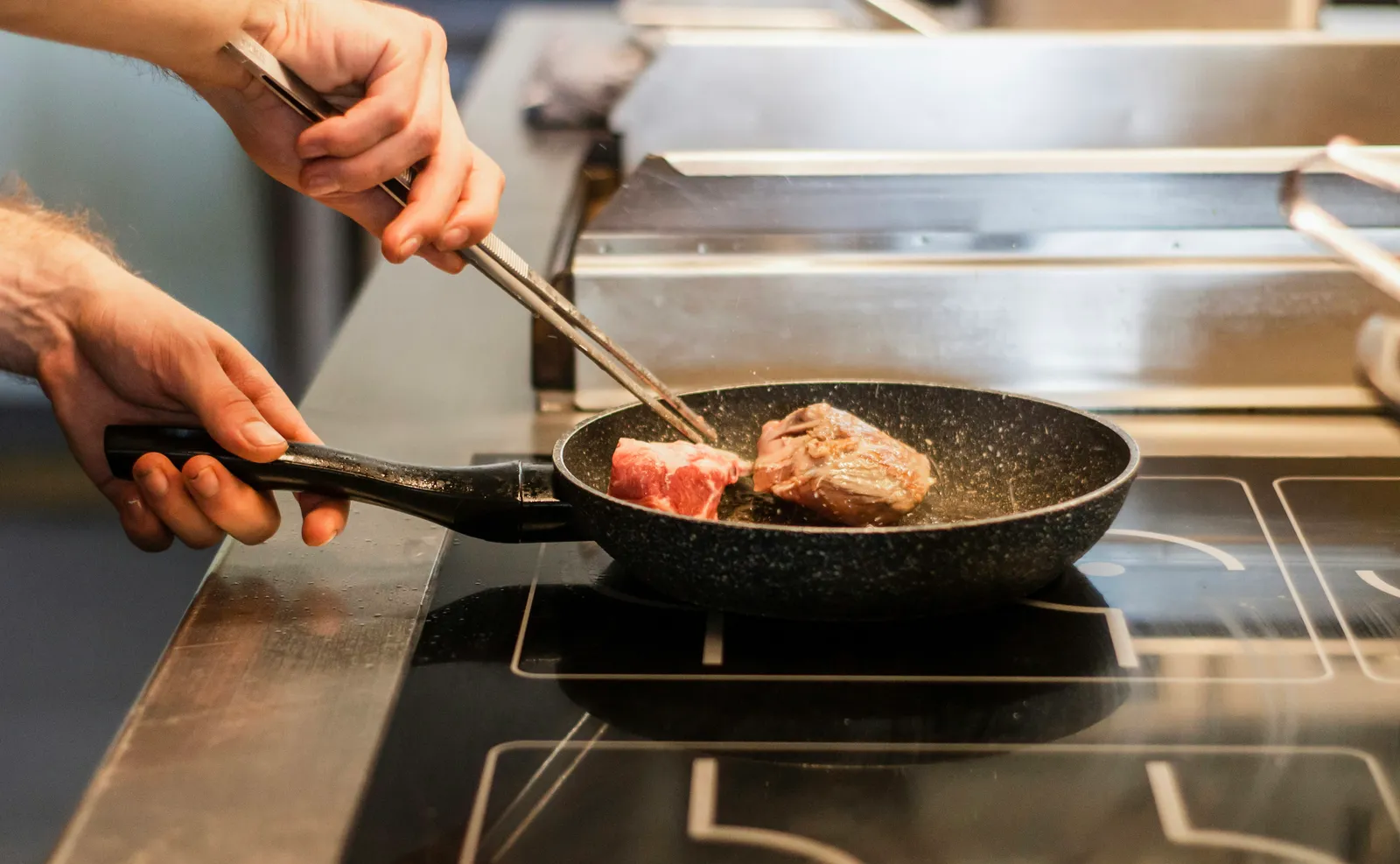
Yes, cast iron works on induction, and it works well: induction only heats magnetic pans, and cast iron is about as magnetic as cookware gets. Every brand page stops there. What they leave out is why your steak sears dark in the middle and pale at the edges, or why a 12-inch skillet seems to have a cold rim on a portable burner.
Using cast iron on induction comes with one real catch, and it has nothing to do with whether the pan works. Induction heats a circle, and cast iron is slow to share that heat with the rest of the pan. Below is why that happens, and the five habits that fix it.
Who this is for
You have an induction cooktop or a portable induction burner (or you are about to buy one) and a cast iron skillet, griddle, or dutch oven, bare or enameled. Maybe you just switched from gas and your pan cooks differently than it used to. Maybe you are wondering whether a vintage Griswold will even register on the burner.
If your only worry is scratching the glass, our guide to cast iron on a glass top stove covers that in depth. This article is about how induction heats the pan, and what that changes about how you cook.
TL;DR: yes, and the rules that matter
Yes, cast iron works on induction because iron is magnetic, and induction only heats magnetic pans. The catch: an induction coil heats only the circle of metal above it, and cast iron spreads heat slowly, so the center runs hotter than the edges. Preheat on medium for 5 to 10 minutes, match the pan to the burner, and lift instead of sliding.
- All cast iron works: bare, enameled, Lodge, Le Creuset, Staub, vintage. If a magnet sticks to the bottom, it works.
- The catch is a hot center. Most portable burners have coils about 6 inches across, and cast iron conducts heat at roughly a third to a quarter the rate of aluminum.
- The fix is time, not power. Preheat on medium, longer than you would on gas.
- Match the pan to the zone. On a portable burner, a 10-inch skillet beats a 12-inch.
- Never preheat an empty pan on high or boost. That is how cast iron cracks and enamel crazes.
- Lift, never slide. The cooking surface is still glass.
- Wipe the bottom of the pan before it goes on, or oil bakes into a brown ring on the cooktop.
Does cast iron work on induction? Yes, and here is why
An induction cooktop has a copper coil under the glass. Alternating current through the coil creates a rapidly changing magnetic field, and when a magnetic pan sits in that field, electric currents are induced in the metal itself. The pan heats from within. The glass is not heated directly; it only gets hot from contact with the hot pan.
That is why induction is picky about cookware, and why cast iron is never the problem. Iron is magnetic, so every cast iron skillet, griddle, and dutch oven works. Lodge confirms its cookware is safe on induction cooktops and calls cast iron a great option for them. Plain aluminum, copper, glass, and most ceramic pans are the ones that fail, unless they have a magnetic steel plate bonded to the base.
The magnet test (10 seconds, any pan)
Hold a fridge magnet to the bottom of the pan. If it grabs firmly, the pan works on induction. If it slides off or barely holds, the pan will heat weakly or not at all. With cast iron the magnet always sticks, so this test is mostly for sorting the rest of your cookware.
The catch: induction heats a circle, and cast iron spreads heat slowly
Induction is often marketed as “even heat,” and several cookware brands repeat the claim on their induction pages, some saying it eliminates hot spots. For cast iron, that is close to backwards. Two facts explain why.
What America’s Test Kitchen’s flour test showed
America’s Test Kitchen tested this directly. They dusted flour across skillets on induction burners set to medium. On most burners, the flour toasted golden in a circle in the middle of the pan while the flour around the edges stayed white, and when they measured the coils, the toasted circles matched them.
Most of the portable burners had coils about 6 inches across, compared with the 9-inch bottoms of full-size pots and pans. Only the burners with 8.5- and 9-inch coils toasted the flour evenly across the whole surface. So on most portable burners, the heat starts in a 6-inch circle. Whether it ever reaches the rest of the pan depends on the metal.
Why “induction heats cast iron evenly” is half true
Cast iron is a poor conductor. Its thermal conductivity is about a third to a quarter that of aluminum, which is why Kenji López-Alt calls it “terrible at heating evenly.” On gas, heat pools over the flame. On induction, heat is generated in a circle and creeps outward slowly. That is how you end up with a skillet that scorches in the middle and barely sizzles at the rim. One cook on Reddit described a portable burner that “never properly heated the corners” of a 10.5-inch Lodge, with chicken wings and steaks cooking unevenly as a result.
The half that is true: induction is fast, and cast iron’s thick, heavy body is the best cure for the hot spot once it has had time. Cast iron has a high volumetric heat capacity, so once the whole pan is hot, it stays hot and resists cold spots when food goes in. America’s Test Kitchen’s fix for uneven portable burners is to use a thick, heat-retaining skillet such as heavy-duty cast iron and preheat it a few minutes longer than usual. Cast iron is not bad on induction. It needs the same patience it needs on any burner, slightly more so. Our cast iron vs stainless steel comparison covers this conductivity-versus-retention trade-off in more detail.
Portable burners vs built-in cooktops
Most hot-spot complaints come from portable single-burner units. Small coils keep them compact and cheap, and ATK found the circle printed on the glass is often larger than the coil underneath. The ring you line your pan up with is a placement guide, not the heated area.
Built-in cooktops usually offer zones in several sizes, and the largest gets much closer to a skillet’s base. On any cooktop, put your biggest pan on your biggest zone. Portable burners also often have a “temperature mode” that displays degrees. ATK notes that the number is the temperature of the bottom of the pan, not the food, so treat it as a rough guide rather than a thermometer.
How to use cast iron on induction (step by step)
These five habits cover every real problem cast iron has on induction: uneven heat, cracking, scratching, and the stovetop ring.
1. Match the pan to the zone
A 10.25-inch skillet measures 10.25 inches across the rim, but its flat base is roughly 8 inches (the sides flare out; our skillet sizes guide explains the rim-versus-base gap), which suits a medium-to-large zone. On a portable burner, ATK suggests a 10-inch skillet over a 12-inch for exactly this reason.
Do not go too small, either. Lodge notes that many induction cooktops detect the size of the pan, and Le Creuset warns that a base much smaller than the zone may get reduced heat or none at all. For a long griddle that spans two zones, Lodge suggests a bridge element if your cooktop has one.
2. Preheat on medium, longer than you think
Set the zone to medium (roughly the middle of your cooktop’s scale), add a thin film of oil, and give the pan at least 5 minutes, closer to 10 for a 12-inch skillet or a griddle. Serious Eats recommends preheating cast iron on a burner for at least 10 minutes to heat it evenly. Lodge’s visual cue: when the oil shimmers and ripples, the pan is ready, and if it starts to smoke, take the pan off the heat for a minute or two.
Once the whole pan is hot, you can turn the zone up to sear. Our steak method works the same way on induction; the only change is the longer preheat at the start.
3. Check your hot spot with the flour test
You can run ATK’s test at home in a few minutes, and it tells you more about your cooktop than any spec sheet. Put the clean, dry pan on the zone, dust a thin, even layer of flour across the whole cooking surface, and heat on medium. Watch where the flour starts to toast. That disc or ring is the coil’s footprint. Turn the heat off as soon as the pattern is clear; do not let the flour burn and smoke.
If only the center browns, plan on longer preheats and keep delicate food away from the hot middle until the pan evens out. If the whole surface browns at once, that zone is a good match for that pan. Dump the flour and wipe the pan clean.
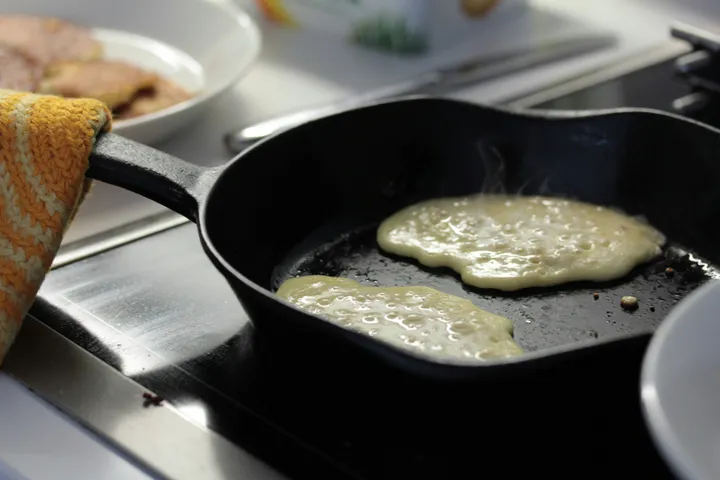
Pancakes are a tastier version of the same test: on a hot-centered pan, the middle cake browns first and the edge cakes stay pale. Our pancake guide covers the heat control that fixes it.
4. Lift, never slide
Induction cooktops are glass-ceramic, so the usual glass-top rules apply: lift the pan to move it, keep grit off the glass and the pan bottom, and set heavy pans down gently. Shaking a pan back and forth on the glass, a habit from gas cooking, counts as sliding.
5. Wipe the bottom of the pan before it goes on
This is the downside almost nobody warns you about. One of the most upvoted induction threads on Reddit’s cast iron forum shows an induction burner coated in a baked-on ring of residue, captioned “a well-seasoned stovetop.” Oil on the outside of the pan transfers to the glass, the hot pan bakes it, and it polymerizes just as seasoning does on the pan.
Wipe the base of the pan dry before every use. After you season the pan, make sure no oil is left pooled or tacky on the underside. Wipe the zone once it cools after cooking.
Can cast iron crack or warp on induction?
Yes, but it is uncommon, and the cause is how you heat the pan, not induction itself. Iron expands as it heats. If the center gets very hot while the rim is still cool, the pan is under stress, and induction can create that difference quickly because it is so efficient and all of its energy lands in one circle. Lodge warns that heating a skillet too quickly can cause thermal shock and, in severe cases, break the cookware on the stovetop. The medium preheat in step 2 doubles as crack insurance.
The real risk factors, worst first:
- An empty pan on high or boost. There is nothing in the pan to absorb the energy, and maximum power is going into a small circle. This is the one to avoid.
- A large pan on a small coil. This produces the hottest center and the coolest rim, so the most stress.
- Sudden cold. Cold liquid poured into a very hot pan, or a hot pan set in a cold sink. Thermal shock works in both directions.
- Thin pans. Cast iron is poured 5 to 7 mm thick, while carbon steel is rolled 2 to 3 mm thick and warps far more readily. Our cast iron vs carbon steel breakdown covers why.
A thick cast iron skillet preheated on medium is about as low-risk as cookware gets. Enamel is less forgiving, as the next sections cover.
Will cast iron scratch an induction cooktop?
It can, but only through sliding or trapped grit, never from the pan’s weight sitting on the glass. Modern Lodge pans have a slightly rough, pebbled base that matters only if you drag it; machined-bottom pans and most vintage pieces are smoother. Lift the pan, keep both surfaces clean, and the glass stays unmarked. The full breakdown, including a risk ranking and how to sand a rough pan bottom smooth, is in our cast iron on a glass top stove guide.
Enameled cast iron on induction (Le Creuset, Staub, Lodge)
Le Creuset works on induction, and so do Staub and Lodge’s enameled line: under the enamel is the same magnetic cast iron. Le Creuset lists induction among its approved heat sources. The difference is that enamel is a layer of glass, and glass handles sudden temperature changes worse than bare iron does.
Le Creuset’s care and use instructions say to use low to medium heat, never to preheat on maximum or high, and warn that thermal shock can craze, crack, or chip the enamel. They also say to match the base diameter of the pot to the induction zone, since a small base on a large zone may get reduced heat or none at all.
That makes the boost setting the worst habit for an enameled pot. Bring a dutch oven up on medium, and never heat one empty on high. If you are deciding between the two kinds of pot, our cast iron vs enameled dutch oven comparison covers where each one wins.
Vintage cast iron, heat rings, and warped bottoms on induction
Vintage pans work fine. Many pre-1960 skillets have a heat ring, a raised ridge on the underside (our vintage cast iron guide explains where it came from), which holds most of the base a few millimeters off the glass. Lodge says a few millimeters of gap between the pan and the burner will not affect induction performance.
Warped pans are a different story. A “spinner” with a bowed base rocks on flat glass, which makes it easy to scrape the cooktop and gives uneven contact and uneven heat. Lay a ruler across the bottom: if light shows underneath or the pan spins when you nudge the handle, keep that pan for the oven or a gas burner.
The brown ring on your cooktop (and how to get it off)
If you already have the polymerized ring from step 5, it is baked-on oil, not damage to the glass. Let the cooktop cool completely, apply a glass-cooktop cleaner, and work the ring with a razor scraper made for glass cooktops, held nearly flat against the surface. Stubborn rings usually take several passes. Check your cooktop’s manual first, since manufacturers specify which cleaners and scrapers they approve. Then keep it from coming back with a dry pan bottom.
Which cast iron skillet works best on induction?
The one you already own, sized to your zone. If you are buying, the Lodge 10.25-inch (about $30 and 5.7 pounds) is the best fit for most induction cooktops: its roughly 8-inch flat base suits a medium-to-large zone, and its thickness smooths out the hot spot once it is preheated. A 12-inch (about 7.7 pounds) earns its place only if you have a large zone to match it.
Smooth-bottomed premium pans such as Stargazer ($120) and Smithey ($230) are gentler on glass if you are prone to sliding pans, but they do not fix the hot spot; the coil size does not change. Our best cast iron skillet guide compares them against Lodge.
What to skip
- Preheating an empty pan on high or boost. It is the fastest route to a cracked skillet or crazed enamel, and it does not save much time, because the edges still lag behind.
- Trusting “even heat” marketing. Induction heats a circle. Cast iron needs time to spread it.
- A 12-inch skillet on a 6-inch portable coil for searing. Use a 10-inch, or accept a hot center and cook around it.
- Reading the burner’s temperature display as food temperature. It measures the bottom of the pan.
- Sliding or shaking the pan on the glass. Lift it.
- Paper towels or parchment under a searing pan. It is a popular forum hack for catching splatter, but the glass under a searing pan gets hot from the pan itself, and paper can scorch. Skip it for high-heat cooking.
- Dunking a hot pan in cold water. Let it cool first.
- Writing off a pan that heats unevenly. It is almost always the coil size, not a defective pan.
Frequently asked questions
Does cast iron work on induction?
Yes. Induction only heats magnetic cookware, and cast iron is strongly magnetic, so every cast iron skillet, griddle, and dutch oven works, bare or enameled. The catch is uneven heat: the coil heats only the circle of metal above it, and cast iron spreads heat slowly, so the center runs hotter than the edges. Preheat on medium for 5 to 10 minutes, match the pan to the zone, and lift instead of sliding.
Why is the center of my cast iron pan hotter than the edges on induction?
Because the induction coil is smaller than the pan. America’s Test Kitchen found most portable burners have coils about 6 inches across, against 9-inch pan bottoms, so heat starts in a center circle. Cast iron conducts heat at roughly a third to a quarter the rate of aluminum, so that heat takes time to reach the rim. Preheat longer on medium and use a pan closer to the zone’s size.
Will cast iron scratch an induction cooktop?
Only if you slide it or trap grit under it. The weight of a pan sitting on the glass does not scratch it; abrasion does. Lift the pan to move it, wipe the pan bottom and the cooktop before cooking, and set heavy pans down gently. Rough, pebbled bottoms like a new Lodge’s are the most likely to mark the glass if dragged; machined-bottom and vintage pans are smoother.
Does Le Creuset work on induction?
Yes. Le Creuset, Staub, and Lodge enameled pots are cast iron under the enamel, so they are magnetic and work on induction. Le Creuset’s care instructions say to use low to medium heat, never preheat on maximum or high, and match the base to the induction zone, because thermal shock can craze, crack, or chip the enamel. Never heat an enameled pot empty on boost.
Can cast iron crack on an induction cooktop?
It can, though it is uncommon. Induction can put a lot of heat into the center of a pan quickly, and if the center expands while the rim is still cool, the stress can crack the iron. Lodge warns that heating too fast can cause thermal shock and, in severe cases, break the pan. Preheat on medium, never heat an empty pan on high or boost, and keep cold water away from a hot pan.
Is Lodge cast iron induction compatible?
Yes. Every Lodge piece, bare or enameled, is cast iron and works on induction, and Lodge says its cookware is safe on induction cooktops. Lodge’s own advice: preheat slowly with a little oil until it shimmers, choose a pan close to the burner’s size so the cooktop detects it and heats it evenly, and lift the pan rather than sliding it across the glass.
What pans don’t work on induction?
Anything that is not magnetic: plain aluminum, copper, glass, and most ceramic or stoneware pans, unless they have a magnetic steel plate bonded to the base. Some stainless steel is not magnetic enough either. The quick check is a fridge magnet on the bottom of the pan: if it grips firmly, the pan works on induction. Cast iron always passes.
Related reading
Induction and radiant glass tops share the same surface, so the cast iron on a glass top stove guide is the companion to this one for scratch prevention and diffusers. To size a pan to your zones, the cast iron skillet sizes guide gives the flat-base measurements behind the rim numbers. If you are cooking in enamel, cast iron vs enameled dutch oven covers what the coating changes, and our cast iron dutch oven guide covers the pot itself. For the physics of why thick iron heats slowly but holds heat so well, see cast iron vs stainless steel and cast iron vs carbon steel.
Your cast iron was always going to work on induction. Now you know the part the brand pages skip: the coil heats a circle, and a few patient minutes on medium turn that circle into an evenly hot pan. Size the pan to the zone, give it time, and induction becomes one of the best burners your cast iron has had.