If you have ever seen an old cast iron skillet stamped with a number on the handle and assumed it meant inches, you have run into the most confusing thing about cast iron skillet sizes: the number is not the diameter. A #8 skillet is about 10.25 inches across, not 8. A #10 is about 12 inches. The numbers come from a system that has nothing to do with how big the pan looks, and it trips up buyers and collectors constantly.
This is the complete reference for cast iron skillet sizes: the old number system decoded into actual inches, the modern size lineup with real weights, the cooking-surface-versus-rim gap that makes people buy the wrong pan, and a straight answer on which size you actually need. Every number here is measured, pulled from Lodge’s own published specs and the standard vintage size charts, not estimated.
Who this is for
Anyone shopping for a cast iron skillet and unsure which size to get, anyone who inherited or bought a vintage pan with a mystery number on it, and anyone who has been burned by ordering a skillet that turned out smaller (or heavier) than expected. It is a reference you can bookmark and come back to.
TL;DR: the quick size chart
The fast version, modern sizes by their inch label (how skillets are sold today):
| Common name | Top diameter | Lodge weight | Best for |
|---|---|---|---|
| Mini | 3.5 in | 0.6 lb | Single egg, serving, novelty |
| Small | 6.5 in | 1.9 lb | One to two eggs, sides, toasting |
| Medium | 8 in | 3.4 lb | Eggs, single servings, sauces |
| Standard | 10.25 in | 5.7 lb | The everyday do-everything pan |
| Large | 12 in | 7.7 lb | Family batches, big sears |
| Extra large | 13.25 in | 10.5 lb | Crowds, entertaining |
| Specialty | 15 in | 12.3 lb | Big-batch, near-commercial |
If you want one pan, get the 10.25 inch. The rest of this guide explains the number system, the weights, and the size gotcha in full.
The number system, decoded (why a #8 is not 8 inches)
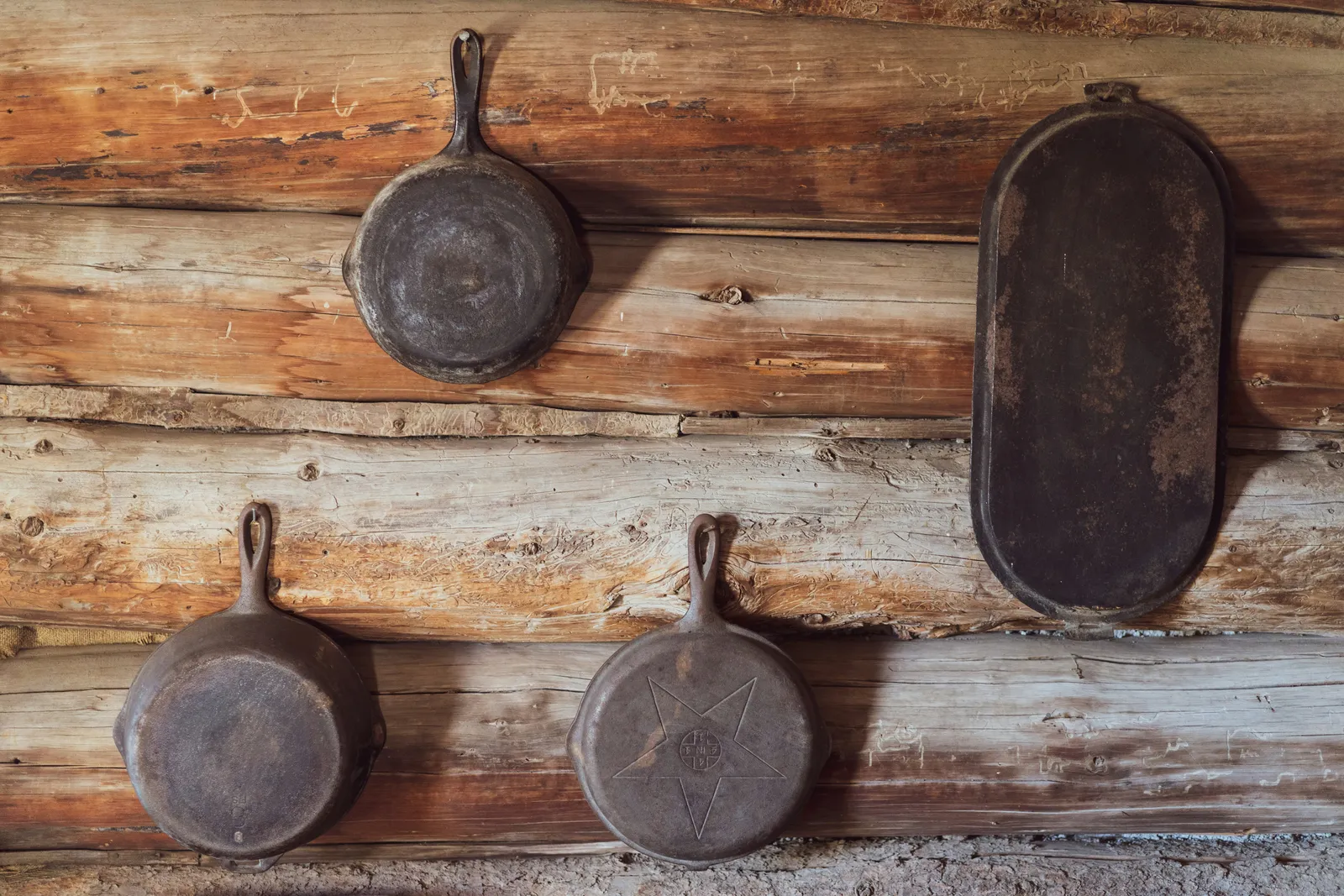
Old cast iron skillets from makers like Griswold and Wagner are marked with a number, usually on the handle or the bottom. That number was never the pan’s diameter. It referred to the diameter of the stove eye, the round removable plate on a wood or coal cook stove, that the pan was sized to drop into. A #8 pan fit the #8 eye. Because the eye was smaller than the pan that sat over it, the number is always smaller than the pan’s actual width.
Here is the standard vintage size chart, the same numbers used across Griswold, Wagner, and other classic makers, measured across the top (rim) and the bottom (the flat cooking surface):
| Number | Top diameter | Cooking surface (bottom) | Depth |
|---|---|---|---|
| #3 | 6.5 in | 5.25 in | 1.25 in |
| #4 | 7 in | 5.75 in | 1.5 in |
| #5 | 8 in | 6.75 in | 1.75 in |
| #6 | 9.1 in | 7.5 in | 1.9 in |
| #7 | 9.9 in | 8.25 in | 2 in |
| #8 | 10.6 in | 8.9 in | 2 in |
| #9 | 11.4 in | 9.5 in | 2 in |
| #10 | 11.75 in | 10 in | 2.1 in |
| #11 | 12.5 in | 10.9 in | 2.1 in |
| #12 | 13.4 in | 11.75 in | 2.25 in |
(Vintage dimensions per the standard collector size charts; see the Pan Man cast iron size and capacity charts for the full table including dutch ovens and roasters.)
The takeaway: a #8 is roughly a modern 10.25 inch, a #10 is roughly a modern 12 inch, and the small #3 and #4 pans are the 6.5 and 7 inch sizes. The number is a foundry-era artifact, not a measure of size or quality. If you want to date and identify an old pan rather than just size it, our vintage cast iron skillet guide covers the maker marks and logos.
Cooking surface vs rim: the size gotcha
Here is the single most useful thing to understand before you buy, and the thing most listings blur: a skillet’s stated size is its top (rim) diameter, but the flat cooking surface on the bottom is always smaller.
A skillet flares outward from base to rim, so a pan sold as “10.25 inch” measures 10.25 inches across the top opening, while the flat cooking area at the bottom (the part that actually contacts a burner and where food sears) is roughly 8 inches. That is a gap of about 2 inches, and it is why people order a 10.25 inch expecting to fit four eggs or two big steaks and find the usable flat space is smaller than they pictured.
The rule of thumb: subtract about 1.5 to 2 inches from the stated size to get the real cooking surface. A 12 inch has roughly a 10 inch cooking surface; an 8 inch has roughly a 6.5 inch surface. When you are deciding whether a pan is big enough for what you cook, the cooking-surface number is the one that matters, not the rim. (You can see the gap directly in the vintage chart above: a #8 is 10.6 inches at the rim but 8.9 inches at the cooking surface.)
Cast iron skillet sizes and weights (the full table)
Weight is the size factor people underestimate, and it is where cast iron earns its reputation. Here are the modern Lodge Classic skillet sizes with Lodge’s own published weights:
| Size (top diameter) | Lodge weight | Roughly equals vintage |
|---|---|---|
| 3.5 in | 0.63 lb | smaller than #3 |
| 5 in | 1.15 lb | near #2 |
| 6.5 in | 1.94 lb | #3 |
| 8 in | 3.44 lb | #5 |
| 9 in | 4.17 lb | #6 |
| 10.25 in | 5.66 lb | #8 |
| 12 in | 7.69 lb | #10 |
| 13.25 in | 10.5 lb | #12 |
| 15 in | 12.3 lb | larger than #12 |
Weights are Lodge’s published figures for the Classic line; other brands vary, with smooth-machined premium pans (Stargazer, Smithey) often a bit lighter and enameled pans heavier. The pattern that matters: weight climbs fast at the top of the range. Going from the 10.25 inch to the 12 inch adds two pounds empty, and from the 12 inch to the 13.25 inch adds nearly three more. A loaded 12 inch with a chicken in it is over ten pounds on one handle.
Small: 6.5 to 8 inch
The 6.5 inch (about 1.9 lb) and 8 inch (about 3.4 lb) are the egg-and-single-serving pans. Light enough to handle one-handed, perfect for one or two fried eggs, a grilled cheese, toasting nuts or spices, melting butter, or a small side. An 8 inch is the size people who already own a 10.25 inch add next.
Medium: 9 to 10.25 inch
The 10.25 inch (about 5.7 lb) is the standard, the one to buy if you buy one. It fits a standard stove burner, handles cooking for one to four people, and covers the large majority of home cooking: searing steak and chicken thighs, frying, baking cornbread, shallow frying. The 9 inch is a slightly smaller, slightly lighter version of the same idea.
Large: 12 inch
The 12 inch (about 7.7 lb) is the family-batch and big-sear pan. More cooking surface for a skillet pizza, a full batch of chicken, or searing several steaks at once. The cost is weight and preheat time, and it can overhang smaller burners. A great second pan, a demanding only pan.
Extra large: 13.25 inch and up
The 13.25 inch (10.5 lb) and 15 inch (12.3 lb) are entertaining and big-batch pans. They are heavy enough that lifting a full one is a two-hand job, and they need a large burner or the oven to heat evenly. Buy these only if you specifically cook for crowds.
What size cast iron skillet do you actually need?
The honest, anti-upsell answer: for most people, one 10.25 inch skillet. It does roughly 80 percent of home cooking, fits standard stoves, and is heavy enough to hold a sear but light enough to handle. The 10.25 inch (the old #8) has been the default American skillet for a century for good reason.
From there, add by actual need, not by buying a set:
- Add an 8 inch if you cook a lot of eggs, single servings, or sides. It is the most useful second pan.
- Add a 12 inch if you regularly cook for four-plus people or sear in batches. Accept the weight.
- Skip the size set. Retailers love selling a 3-piece (8, 10.25, 12) bundle, but most cooks use the 10.25 for almost everything and the others rarely. Buy the 10.25 first, then add only the size you find yourself wishing for.
For the brand-by-brand version of this decision (Lodge vs Stargazer vs Smithey vs Field), see our best cast iron skillet guide. The Lodge Classic 10.25 inch at around $30 is the standard recommendation for a first pan.
Modern labeling vs the vintage number system
To keep the two systems straight:
- Modern pans (Lodge, Stargazer, Smithey, Field, Le Creuset) are labeled by their top diameter in inches. A “10.25 inch” is 10.25 inches across the rim. This is what you see on every current product listing.
- Vintage pans (Griswold, Wagner, and other pre-1960s makers) are marked with a number referring to the stove eye. A “#8” is about 10.25 inches.
The two systems overlap in a tidy way: Lodge’s internal model numbers still echo the old system (the 10.25 inch Classic is model 8SK, the heir to the #8), so a modern 10.25 inch and a vintage #8 are the same working size. If you are comparing an old pan to a new one, match them by actual inches across the top, not by the stamped number.
The oddball sizes (mini, 15-inch, and bigger)
Beyond the everyday range:
- 3.5 inch mini (0.6 lb): a single fried egg, a serving vessel for restaurant-style presentation, or candle-and-trinket duty. Cute, rarely essential.
- 15 inch (12.3 lb): big-batch cooking, paella-scale dishes, feeding a crowd. Heavy and burner-hungry.
- 17 to 20 inch and “double burner” pans: specialty and near-commercial. These exist (you will see “20 inch cast iron skillet” in searches) but they are for serious entertaining, restaurants, or outdoor cooking over a fire, and they require two burners or an oven rack you have measured first.
For most kitchens, anything above 13.25 inches is a want, not a need.
What to skip (the size-buying mistakes)
- Reading the number as inches. A #8 is 10.25 inches. Always convert the vintage number, or measure across the top.
- Buying for the rim measurement. The cooking surface is 1.5 to 2 inches smaller. Buy for the surface you will actually cook on.
- Starting with a size set. You will use the 10.25 inch for almost everything. Buy it first, add later.
- Going straight to a 12 or 15 inch as your only pan. The weight and preheat time make a big pan a poor everyday choice for most cooks.
- Ignoring your burner size. A pan much larger than the burner heats unevenly in the overhang; match the pan to the stove, especially on a glass top or smaller apartment range.
Frequently asked questions
What size is a #8 cast iron skillet?
A #8 cast iron skillet is about 10.25 inches across the top, not 8 inches. The number referred to the wood-stove eye the pan fit, not the pan’s diameter, which is why a modern Lodge 10.25 inch carries the model number 8SK as the heir to the old #8. Its flat cooking surface is around 8 to 9 inches.
What size is a #10 cast iron skillet?
A #10 is about 11.75 to 12 inches across the top, roughly a modern 12 inch skillet, with a cooking surface near 10 inches. As with all the old numbers, the 10 referred to the stove eye, not the pan’s measurement.
How big is a number 3 cast iron skillet?
A number 3 is small, about 6.5 inches across the top with a cooking surface near 5.25 inches. It is a single-egg or small-side pan, what most people would call a 6 to 6.5 inch skillet today.
How big is a number 4 cast iron skillet?
A number 4 is about 7 inches across the top with a cooking surface near 5.75 inches, a small skillet good for a couple of eggs or a single serving. In modern terms it falls between a 6.5 and an 8 inch pan.
What is the difference between a 10 inch and 12 inch cast iron skillet?
More cooking surface and a lot more weight. A Lodge 10.25 inch weighs about 5.7 pounds; the 12 inch about 7.7, and the gap grows when the pan is full. The 10.25 inch fits most stoves and handles everyday cooking for two to four; the 12 inch is the family-batch and big-sear pan but heavier, slower to preheat, and prone to overhanging smaller burners.
Is a 12 inch cast iron skillet too big?
As an only pan, for many cooks yes. A 12 inch weighs about 7.7 pounds empty and well over 10 loaded, preheats slower, and can be wider than a standard burner. It is an excellent second pan for batches and crowds, but if you are buying one skillet, the 10.25 inch is more manageable and does most jobs.
What size cast iron skillet should I buy?
Buy the 10.25 inch (the old #8) as your one pan. It fits standard burners, cooks for one to four people, and handles roughly 80 percent of home cooking. Add an 8 inch later for eggs and single servings, and a 12 inch only if you regularly cook for a crowd. You do not need a three-pan size set to start.
Related reading
Once you know the size you want, the best cast iron skillet guide covers which brand to buy it from, and the vintage cast iron skillet guide decodes the maker marks if you are shopping old pans by their numbers. The weight-by-size tradeoff is the same one we weigh in cast iron vs stainless steel and cast iron vs carbon steel. For the other major cast iron shape and its sizing, see the cast iron dutch oven guide. And whatever size you land on, how to season a cast iron skillet keeps it cooking well for the next hundred years.
Cast iron skillet sizes only seem complicated because two labeling systems collide: the old stove-eye numbers and the modern inch measurements. Convert the number to inches, remember the cooking surface is smaller than the rim, respect the weight at the top of the range, and the choice gets simple. For almost everyone, a 10.25 inch is the answer, and the chart above is here for every time you need to size up an old pan or a new one.