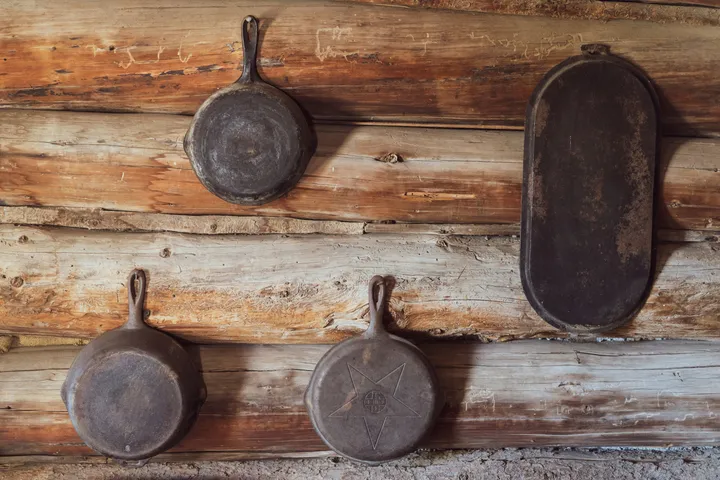
You found a black pan in your grandmother’s basement, or you saw one at a flea market for $40 that the seller said was a Griswold, or you’ve been reading Reddit threads about vintage cast iron and you want to know what’s actually worth it. This guide covers all three: how to identify what you have, what the major American makers were, what they’re really worth, and the honest answer to the question nobody on page one of Google is willing to give clearly: do you actually need a vintage pan, or is a modern Lodge fine?
Who this is for
You inherited a pan and want to know what it is. Or you’re shopping for vintage and want to know what’s worth paying for. Or you’re considering a $200 restored Griswold versus a $30 new Lodge and trying to decide if the upgrade is real. This guide answers all three questions with specific prices, verified maker dates, and the contrarian truth about whether the vintage cooking experience justifies the price for a normal home cook.
TL;DR: do you actually want a vintage cast iron skillet?
- You inherited one. Use it. It probably cooks better than anything in the store today, and if it doesn’t, re-seasoning or rust removal almost always fixes it.
- You’re choosing between vintage and new. For daily cooking, a $30 modern Lodge does 95% of what a $200 restored Griswold does. The vintage advantage is real (smoother surface, lighter weight) but small enough that most home cooks don’t notice.
- You collect or specifically value smooth-machined cookware. Then vintage is worth it. Griswold and Wagner pans from 1900 to 1950 are the gold standard, and there are good reasons collectors pay for them.
- The 5-question identification test below gets you from a pan you don’t know to a likely maker and date range in about two minutes.
That’s the framework. Everything below is the why, the identification tree, the makers, the price tiers, and what to skip.
Why vintage cast iron is different (and where the difference matters)
Pre-1960s American cast iron was sand-cast (same as modern) but then machined smooth on the cooking surface as a finishing step. Mid-twentieth-century manufacturing cost pressure killed that step at most foundries, including Lodge, which now ships pans with the rough sand-cast texture you see straight from the factory. You can recreate that finishing step yourself by polishing a modern cast iron skillet smoother, though there is a right and wrong way to do it (a mirror finish, counterintuitively, stops holding seasoning).
Three real differences this creates:
Smoother surface. A polished vintage cooking surface has less mechanical surface area for protein bonding. Eggs release more easily on a smoother pan, all other variables equal. The effect is small (heat control matters far more, per our eggs guide) but it’s measurable.
Lighter weight. A 10-inch Griswold #8 weighs about 4 pounds. A 10.25-inch modern Lodge weighs about 5.5 pounds. The thinner walls of vintage pans are a function of finer iron grain (pre-WWII foundry practice) and machining-down after casting. Lighter is easier on the wrist, which matters when you cook eggs daily.
Finer iron grain. Smaller crystalline structure means slightly different heat conduction. The practical effect on cooking is minimal, but it’s part of why collectors describe vintage as “cooking differently.”
The reason all three of these matter less than you’d think: a well-seasoned modern Lodge with proper heat control cooks eggs cleanly, sears steak perfectly, and bakes cornbread with a real crust. Vintage gives you a refined version of an experience the modern pan already provides. It’s the difference between a Toyota Camry and a Lexus ES, same drivetrain, different interior.
How to identify what you have (the 5-question decision tree)
Walk through these in order. You don’t need to recognize the logo; you just need to answer five mechanical questions about the pan in your hand.
Step 1: is there a logo or maker mark?
Look at both sides (top of cooking surface and back/underside). The most common locations:
- Bottom of the pan, in the center, most American makers (Griswold, Wagner, Lodge) marked here
- Back of the handle, some early pieces, plus a few Canadian makers
- Inside the cooking surface, near the top edge, rare but seen on some unusual pieces
If you find no marks at all, the pan is either an unmarked piece from a small foundry or a stripped-of-seasoning pan where the marks have been worn down by aggressive scrubbing. Unmarked is not the same as worthless. Many unmarked pans are perfectly good cookware. They’re just hard to value at sale.
Step 2: where on the pan is the marking, and is there a “heat ring”?
A heat ring is a raised circular ridge on the back of the pan, near the outer edge, that lets the pan sit flat on a wood-stove eye. Heat rings are very common on pre-1960 American skillets and mostly gone on modern ones. Lodge dropped the heat ring on most lines in the 1960s. A heat ring is one of the single best vintage indicators.
If the mark is inside a heat ring, you’re almost certainly looking at a vintage piece. If there’s no heat ring and the bottom is smooth, the pan is either modern or a few specific late-era vintage lines (post-WWII Griswold “smooth bottom” pieces are an exception).
Step 3: handle shape and hanging hole
Vintage handles vary enough to be diagnostic:
- Long, rounded handle with a small hanging hole at the end: classic Griswold/Wagner/Erie shape
- Long, straight handle with a teardrop-shaped hole: later Griswold and some Wagner
- Short, thick handle with no hole: often Lodge older pieces (1910s-1940s) and a number of small-foundry pans
- Handle with cooling fins or grooves on the back: post-WWII design, not pre-war vintage
Compare the handle to images of known makers. The Cast Iron Collector site’s manufacturer pages have photos of handles for the major brands.
Step 4: the size number
Older American pans are stamped with a size number (typically 3 through 14) that refers to stove-eye fit on a wood-burning stove, not inches across the cooking surface. A “#8” pan is roughly 10.5 inches across the top, not 8 inches. A “#10” is about 11.75 inches. A “#3” is about 6.5 inches. The full cast iron skillet sizes chart decodes every number to its modern inch equivalent, with measured weights.
If the pan is marked with a fraction like “10 1/4 in” or “12 in”, that’s a modern convention (Lodge introduced inch-based marking in the mid-20th century). Pre-1960 pans almost always use the size-number system.
Step 5: cross-reference to a maker
With the logo (if any), handle shape, heat ring presence, and size number in hand, cross-reference to the canonical maker list (see the section below). For pans with logos, the Cast Iron Collector reference is the gold-standard source for verified maker dates and trademark history. Use their identification pages to confirm what trademark variant you have, that’s how you pin a date range.
The major American makers worth knowing
All dates verified via the Cast Iron Collector reference, which is the closest thing the vintage cast iron community has to a canonical primary source.
Griswold Manufacturing Co., Erie, PA, 1885 to 1957. The most prized American maker. Trademark history: early pieces are marked ERIE only (pre-1906), then GRISWOLD’S ERIE (~1906 to 1909), then the iconic “slant logo” (stylized italic GRISWOLD inside a cross-in-double-circle, from ~1909 into the 1940s), then later block-letter trademarks. Brand lines include Erie (1880 to 1905), Griswold’s Erie, Victor (economy), Iron Mountain (unmarked, 1940s), and Good Health.
Wagner Manufacturing Co., Sidney, OH, 1891 to 1959. The other gold-standard maker. Brands include Wagner (1891 to 1930s), Sidney (1905 to 1929), Wagner Ware (1914 to 1959), National (economy), and Long Life. Wagner pans are typically lighter than Griswolds of comparable size and very smooth.
Lodge Manufacturing Co., South Pittsburg, TN, 1910 to present. Yes, vintage Lodge is a thing. Pre-1960s Lodge pieces with the older block-letter logo and a heat ring are collected, though they don’t command Griswold-level prices. The brand has continuously produced cast iron longer than any American maker.
Birmingham Stove & Range Co. (BSR), Birmingham, AL, 1902 to 1990s. Mid-tier American maker. Lines include Red Mountain (1930s to 1950s), Century (1950s to 1992), Pioneer (1970s), and Lady Bess (1970s to 1990s). BSR pans are workhorse-quality, less prized by collectors but excellent cookers.
Favorite Stove & Range Co., Piqua, OH, 1916 to 1935. Short production window means rarer pieces. Brands include Favorite Piqua Ware, Miami (economy), and Puritan (Sears Roebuck contract).
Martin Stove & Range Co., Florence, AL, 1917 to 1953. Brand lines include Martin and Perfection. Solid Southern foundry, less collected than Griswold or Wagner but reliable cookers.
Wapak Hollow Ware Co., Wapakoneta, OH, 1903 to 1926. The shortest-lived of the major American foundries; Wapak pieces are rare. Brands include Wapak and Oneta (economy).
Erie is not a separate company. Many sources list “Erie” as a vintage maker. It’s a Griswold brand line from 1880 to 1905, before Griswold put their own name on most pans. If you have an “ERIE” pan, you have an early Griswold.
Other foundries (Sidney Hollow Ware, Vollrath, Columbus Hollow Ware, Marion Stove, dozens more) produced quality pans, but the seven above are the ones you’ll most commonly encounter and the ones with established collector markets.
Vintage cast iron skillet value (real prices, not Pinterest values)
Loose price tiers based on current marketplace conditions (eBay sold listings + reputable restoration sellers):
| Tier | What you get | Price range |
|---|---|---|
| Bargain | Small unbranded skillets, mid-century BSR, post-WWII Lodge with light wear | $30 to $80 |
| Mid | Restored Wagner or Wagner Ware in common sizes, smaller restored BSR, well-preserved unmarked smooth-cooking pans | $80 to $150 |
| Collector entry | Restored Griswold #6 to #9 with slant logo, mid-size Wapak, restored Favorite pieces | $150 to $300 |
| Collector | Restored Griswold #3 (small, rarer), Griswold #11 to #14, late ERIE pieces, rare brand variants | $300 to $500 |
| Rare / auction | Spider skillets, hammered-finish Griswolds, full Griswold sets, certain Wapak variants | $500 to $5,000+ |
Condition affects value as much as maker. A flat, properly restored, no-cracks Wagner #8 is worth more than a warped or cracked Griswold #8. The same maker’s pan in different condition can have a 3x price spread. Inspect first; price-by-maker after.
Buyer’s note: prices on flea markets and estate sales run 30 to 50% below restored-seller prices because you’re absorbing the restoration work yourself. A $40 estate-sale Griswold often needs 4 to 8 hours of stripping, derusting, and re-seasoning before it cooks well. The $200 restored version comes ready to use. Both have their place.
Should you buy vintage, or just buy a modern Lodge?
The honest answer most articles won’t give you: for daily-use cooking, a modern Lodge does 95% of what a vintage Griswold does, at one-eighth to one-tenth the price. Our skillet buying guide walks through the modern options in detail; the short version is that the $30 Lodge 10.25” Classic remains the value benchmark, full stop.
Vintage is worth the premium if any of these apply to you:
- You cook eggs every day and the 10% sticking difference matters
- You have wrist or hand issues and the 1.5 pounds of weight savings matters
- You collect or appreciate the craftsmanship of pre-war American manufacturing
- You inherited one and want to honor the heirloom by using it
- You want a smoother cooking surface and don’t want to spend $200+ on a Stargazer or Smithey, which deliver smoothness in modern form for less money than collector-tier vintage
Vintage is not worth the premium if:
- You’re a new cast iron cook and you’d be using vintage as your first pan
- You cook on cast iron only occasionally
- You’re looking for “the best” for daily steak/burger/cornbread cooking; modern Lodge handles those identically
- You’d be buying based on a single “vintage is better” article online rather than a specific use case
Modern smooth-finish brands (Stargazer at ~$150, Smithey at ~$230, Field at ~$160) give you the smoothness of vintage in new manufacture with warranties, which for most buyers is the better trade than spending the same money on uncertain-condition vintage.
Where to buy vintage cast iron (and what to pay)
Flea markets and estate sales ($20 to $80 typical). Lowest prices, highest condition variance. You inherit the restoration job. Bring a straight edge to test for flatness on site.
eBay ($40 to $300+ for restored, $20 to $80 for as-found). Massive selection. Filter for “Buy It Now” + “Used” + specific maker, sort by price plus shipping. Read seller feedback carefully; restored sellers with 99%+ feedback are reliable. Avoid pans listed with “untested” or “as-is” if you’re not ready to restore.
Reputable restoration sellers ($80 to $300+ for ready-to-use). Hardmill, Cast & Clara Bell, Cast Iron Chris, and others sell pre-restored vintage pans with their work guaranteed. Highest prices but lowest risk; you’re paying for the professional restoration time you’d otherwise spend yourself.
Antique shops in rural areas ($40 to $150). Variable. Better in the South (Wagner and Lodge country) than in cities. Worth checking if you’re already traveling.
Avoid: rural roadside sellers without clear provenance, listings without close-up photos of the bottom, anything described as “rare” without a specific maker and date claim, and any pan sold “as-is from a barn find” at restored prices.
What to avoid when buying vintage cast iron
- Cracks. Any visible crack means the pan will eventually fail under thermal stress. Don’t buy it for cooking. (Wall-hanger display only.)
- Heat warp. Lay a straight edge or ruler across the cooking surface. If light shows through under it, the pan is warped. Warped pans cook unevenly forever (the burner can’t heat a non-flat surface uniformly) and cannot be flattened by re-seasoning.
- Deep pitting from rust. Surface rust is fixable in 20 minutes per our rust guide. Pits you can feel with your fingernail are usually permanent; food sticks in them.
- Pans with active rust that goes through to the back. Surface rust on one face is recoverable. Through-and-through rust suggests the iron itself is compromised.
- Refinished pans that have been wire-wheeled to bare metal. Some restorers over-strip pans, removing both the rust and the desirable patina that took decades to develop. Look for restored pans with intact dark seasoning, not pans that look factory-new-bare.
- “Reproduction” or “antique-style” pans. Some current manufacturers cast pans designed to look vintage. They’re not actually vintage and aren’t priced as such. Verify maker dates against the Cast Iron Collector reference before paying vintage prices.
- Sellers who can’t tell you the maker and date range. A seller asking $200 for “an old Griswold or maybe Wagner, not sure” is either uninformed or hoping you are. Pass.
Caring for a vintage cast iron skillet (what’s different from modern)
The fundamentals are the same as for any cast iron pan: the daily clean routine (rinse, scrub, dry on the stovetop, wipe with oil), the seasoning method (450°F, 1 hour, repeat 3-4 times for stripped pans), and the oil choice (grapeseed for general use).
Three things that differ on vintage pans:
Restore before first use if you acquired it as-found. A vintage pan from a flea market or estate sale almost always needs a rust check, possible strip, and re-seasoning. Our re-seasoning guide walks through the 5-scenario diagnostic; most vintage finds land in the “fundamentally compromised, do a full strip” scenario because the seasoning is decades old and oxidized.
Don’t run a vintage pan through a self-clean oven cycle if the pan is rare or particularly thin-walled. Self-clean is the fastest strip method for modern Lodge but the 800°F+ temperatures can stress old iron more than expected. For collector-tier Griswolds or Wagners, use the lye-based oven-cleaner method instead (slower but gentler on the metal).
Use it on the stovetop, not in the campfire. Vintage pans are not less durable than modern Lodge, but they’re not more durable either. Treat them as cooking tools, not as field gear, and they’ll outlast you.
FAQ
How can I tell if my cast iron skillet is vintage?
Run the five-question test: is there a maker mark, where is it located, what shape is the handle, is there a heat ring on the bottom, and what size number is stamped. The combination usually identifies the maker and a 20-30 year date range. A pan with a heat ring, a long rounded handle with a small hanging hole, and a single-digit size number is almost certainly pre-1960 American vintage.
Is vintage cast iron actually better than modern Lodge?
It’s smoother and lighter, both real advantages. Whether the advantages justify the price (often 5x or more) depends on your cooking. For daily eggs and crepes, vintage cooks slightly better. For steak, burgers, cornbread, and pizza, modern Lodge is functionally identical.
How much is a vintage cast iron skillet worth?
$30 to $80 for unbranded or BSR pans, $80 to $150 for restored Wagner, $150 to $300 for restored Griswold common sizes, $300 to $500+ for rare Griswolds, $500 to $5,000+ for collector pieces (spiders, hammered finishes, complete sets). Condition matters as much as maker.
What are the best vintage cast iron brands?
Griswold (1885 to 1957) and Wagner (1891 to 1959) are the top tier. Vintage Lodge, BSR, Wapak, Favorite, and Martin are second-tier collected makers. Erie is a Griswold brand line, not a separate company.
How do I know if a vintage skillet is real Griswold?
The slant logo (a stylized italic GRISWOLD inside a cross-in-double-circle) is the most iconic and easiest to recognize. Pieces marked just “ERIE” (pre-1906) or “GRISWOLD’S ERIE” (~1906 to 1909) are also authentic Griswold from the early period. The canonical reference for confirming any Griswold mark is the Griswold trademark page on castironcollector.com.
Can you still cook on a 100-year-old cast iron skillet?
Yes, as long as the pan is flat and uncracked. Cast iron does not degrade chemically with age. A century-old Griswold or Wagner that has been cleaned, rust-removed, and re-seasoned cooks every bit as well today as it did when it was new, and often better than a modern equivalent because the surface is smoother.
What this gets you
You can now walk into an estate sale, pick up an unfamiliar pan, run through five questions, and walk out with either a $40 Griswold #8 you knew the value of or a confident “nope, post-1970 unmarked” pass. You know what’s worth $30 and what’s worth $300. You know to bring a straight edge for the flatness test and to skip anything that’s cracked, deeply pitted, or warped. And you know the honest answer to the article most search results won’t give you: vintage cast iron is wonderful, modern Lodge is excellent, and the right choice depends on your cooking, not on what a Pinterest post said.