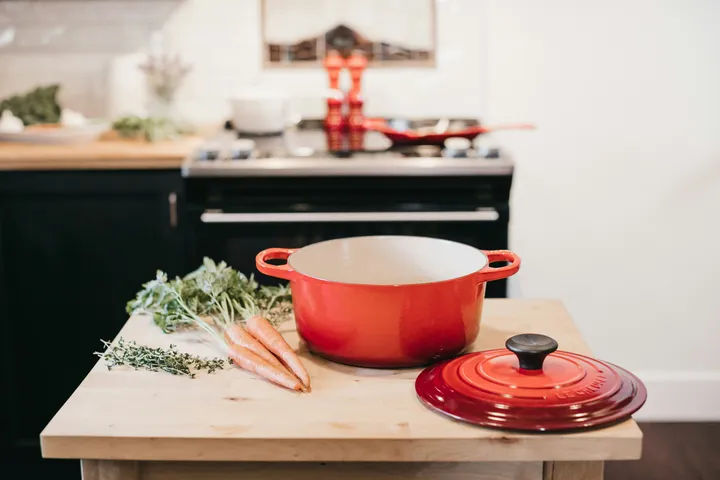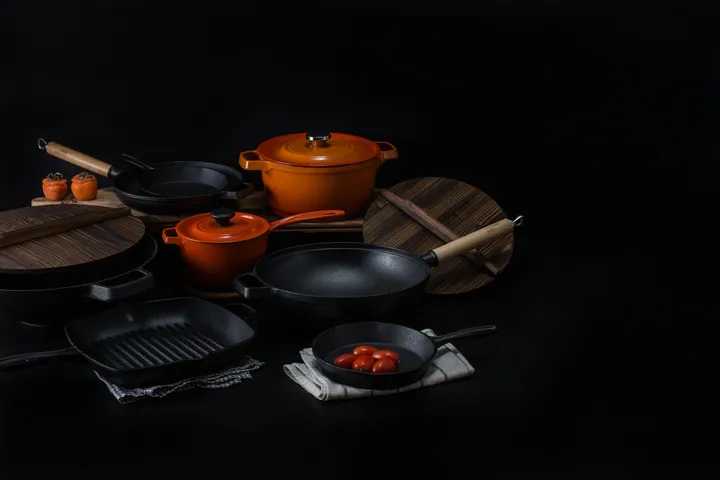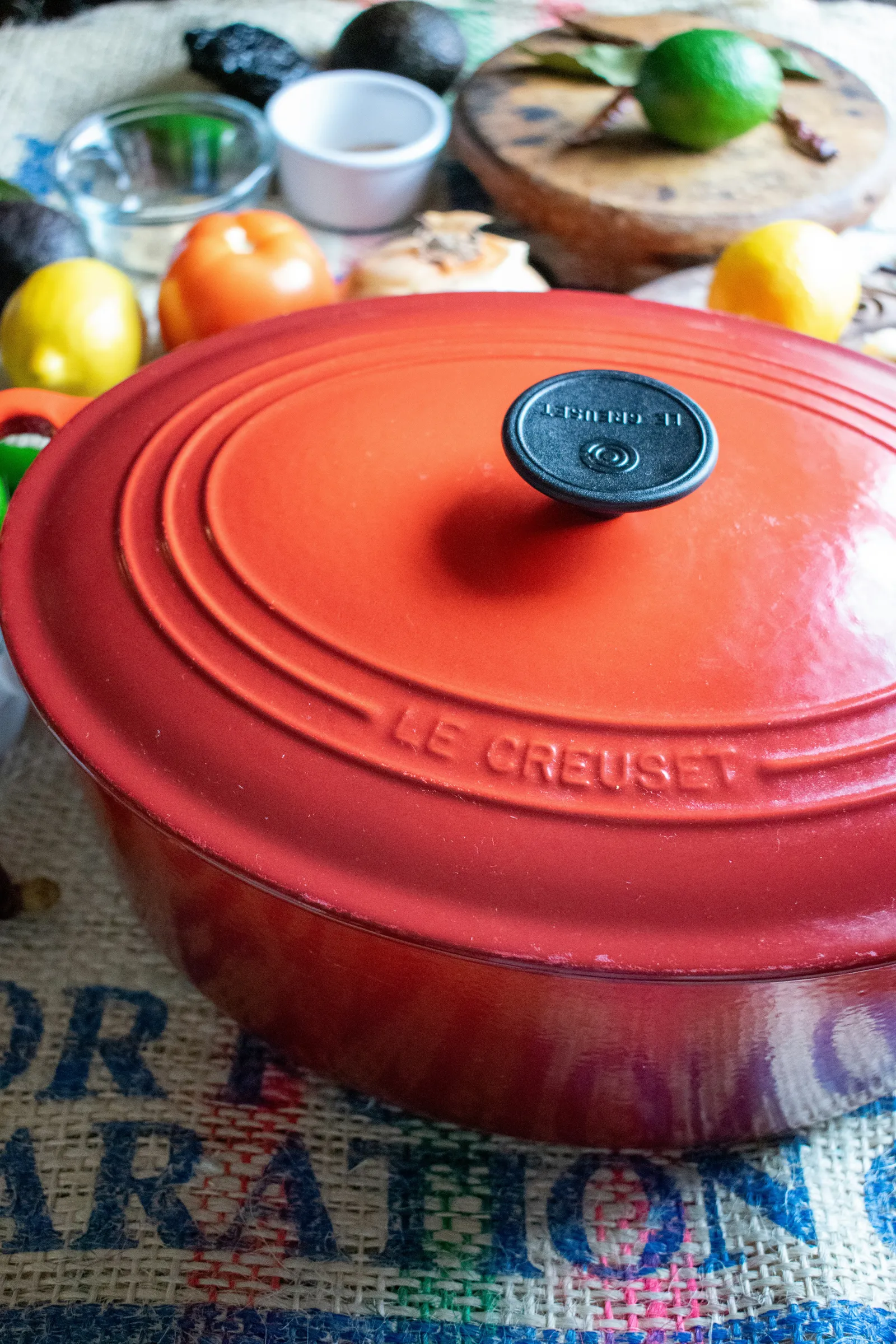
Lodge vs Le Creuset dutch oven is the classic value-versus-premium question in cast iron, and the numbers make it stark: the Lodge enameled Dutch oven runs about $80, while Le Creuset’s flagship 5.5-quart runs around $420. That is roughly five times the price for a pot that cooks the same food. So the real question is not which cooks better, because they are nearly identical there, but what the extra $340 actually buys, and whether those things matter to you. This guide breaks it down with verified prices, weights, and warranty terms, and gives you a straight answer.
Who this is for
You want one good Dutch oven for braises, soups, stews, and bread, and you have hit the wall every buyer hits: a cult-favorite Le Creuset at $420, and a Lodge that does the same job for $80. You have heard “Lodge is just as good” and you have heard “Le Creuset is worth every penny,” and both camps sound confident. You want the honest middle: where the money goes, where it does not, and which pot is right for how you actually cook. That is exactly what this compares.
TL;DR: the verdict
For most home cooks, the $80 Lodge enameled Dutch oven is the smart buy. Hands-on testers at The Kitchn found “no need to splurge” on performance grounds, and we agree: it cooks within a hair of the $420 Le Creuset. The premium buys three real things, in order of how much they matter: a more chip-resistant enamel, a lifetime warranty that owners say is honored generously, and lighter weight. Pay it only if those specifically matter to you. If they do not, the Lodge is one of the best values in the kitchen.
Lodge vs Le Creuset at a glance
| Lodge Essential Enamel (6 qt) | Le Creuset Signature (5.5 qt) | |
|---|---|---|
| Price | ~$80 | ~$420 |
| Made in | China or Vietnam | France |
| Weight | ~14 lb | ~11.4 lb |
| Enamel durability | chips/stains more (per owners) | more chip-resistant |
| Warranty | limited lifetime, voidable by misuse | lifetime, liberally honored |
| Max oven temp | 500°F | 500°F |
| Cooking performance | excellent | excellent |
| Color options | a handful | dozens |
| Best for | value; most home cooks | durability, warranty, weight, looks |
Prices and weights verified on the brands’ own pages and The Kitchn’s hands-on review; enamel durability reflects long-term owner reports, covered below.
Price: $80 vs $420, and what the gap buys
Start with the honest anchor. The Lodge enameled Dutch oven lists at about $80 (often discounted below that), and Le Creuset’s flagship 5.5-quart Signature Round runs about $420, sometimes $435 depending on color. Staub, the other French premium option, usually lands a bit under Le Creuset, especially on sale.
That is a $340 gap on cooking tools that produce the same braise. It is worth being clear-eyed about what a premium pot is and is not. It is not better heat retention: both are cast iron with the same thermal mass, so both hold a low, steady braising temperature for hours (the same heat-retention physics that makes any cast iron good at this). It is not better cooking. What the premium actually buys is finish quality and ownership experience: enamel that resists chipping longer, a warranty that replaces the pot when things go wrong, less weight in your hands, and a range of colors. Whether that is worth $340 is a personal call, not a cooking one.
Before you even reach this decision, it is worth asking whether you want enameled at all. A bare Lodge Dutch oven costs around $60 and is more naturally nonstick, if you do not mind seasoning it. We cover that upstream choice in cast iron vs enameled Dutch oven; this comparison assumes you have decided on enameled and are choosing a brand.
Cooking performance: is there a real difference?
Barely. This is the part the price makes hard to believe, but multiple hands-on tests land in the same place: a Lodge enameled Dutch oven sears, braises, simmers, and bakes bread about as well as a Le Creuset. The Kitchn’s testers put both through the same paces and concluded there was no need to splurge for results. A decade-old forum thread of side-by-side owners reached the same verdict: “the Lodge performed just as well as my tried-and-true Le Creuset.”
There are two small, real cooking differences. Le Creuset’s cream-colored interior enamel makes it easier to see how much browning (fond) has developed at the bottom of the pot, which helps when you are building a braise; Lodge’s lighter interior is similar, while Staub’s black interior hides it. And Le Creuset’s slightly lighter weight (more on that below) makes it a touch easier to maneuver a full pot. Neither changes the food on the plate. If your decision hinges on cooking results alone, buy the Lodge and spend the difference on groceries.
Durability: the chipping and staining question
This is where the premium earns part of its keep, and where “Lodge is just as good” oversimplifies. The most consistent real-world complaint about Lodge’s enameled line is that the enamel chips and stains more readily than Le Creuset or Staub.
The evidence is owner and retail experience, not a lab test we ran, so weigh it as such. A retail worker who sells all three brands reported handling several Lodge enamel returns for chipping or cracking within a month of purchase over a year, against effectively none for Staub and one for Le Creuset. A separate owner who has baked high-temperature bread in all three for five years reported that the Lodge developed chips in the enamel and stains that would not come out, while the Le Creuset and Staub held up. Plenty of Lodge owners have zero problems, so this is a difference in odds, not a guarantee. But across many pots, the premium enamel is measurably tougher.
Two practical takeaways. First, if you buy Lodge, treat the enamel gently: no metal utensils, no heating it empty, and pad it with pot protectors when you stack it (all of which, notably, are also conditions of the warranty). Second, if you are the kind of cook who is hard on cookware, the durability gap is a legitimate reason to pay up.
Warranty: the hidden half of the value equation
Here is the factor most comparisons skip entirely, and it is half of what “buy it for life” actually means.
Le Creuset backs its cookware with a lifetime warranty, and owners repeatedly describe it as honored with unusual generosity. In the words of one: “I messed up a pot and they sent me a new one, no questions asked, no shipping fees.” That kind of replacement, even for owner error, is a real part of the $420, and it is why some buyers treat a Le Creuset as a genuine lifetime purchase.
Lodge also offers a warranty, its Made Right limited lifetime warranty, but read the word “limited.” It covers manufacturing defects, not damage you cause, and it is explicitly voided by common mistakes: heating the pot empty on the stovetop, stacking without protectors, using it on a campfire, or cooking on uncontrolled heat like a charcoal or pellet grill. It is a reasonable defect warranty, but it is not the “we will replace it no matter what happened” experience Le Creuset owners describe. If a warranty that forgives your own accidents matters to you, that is a concrete thing the premium buys.
Weight, handles, and everyday feel
Cast iron is heavy, and the premium pot is meaningfully lighter. The Lodge 6-quart weighs just over 14 pounds; the Le Creuset 5.5-quart is about 11.4 pounds, per The Kitchn’s measurements. Nearly three pounds is a lot when you are lifting a full pot of stew out of a hot oven with mitts on, and for smaller cooks or anyone with wrist issues it is a daily-use difference, not a spec-sheet one.
Handles matter too. Le Creuset’s wide loop handles are easier to grip with thick oven mitts, and its standard knob is oven-safe to high temperatures. Staub goes further with a metal lid knob rated for any oven temperature. Lodge’s handles are functional but smaller. None of this is decisive, but it is part of why the premium pots feel nicer in daily use even when they cook the same.
Made in China or Vietnam vs made in France
The origin gap is real and worth understanding, because it is most of why the prices differ. Lodge states plainly that its enameled cookware is “made by our trusted partners in China or Vietnam,” to Lodge’s specifications. (Note this applies only to the enameled line; Lodge’s bare cast iron is still made in the USA, in South Pittsburg, Tennessee.) Le Creuset has been crafting its enameled cast iron “by French artisans” since 1925, and Staub is likewise French-made.
That difference in labor and finishing is a large part of the price gap, and it correlates with the durability difference above. It does not make the Lodge unsafe or low quality, Lodge holds its overseas partners to its metallurgical standards and the pots are food-safe, but if country of origin or hand-finishing matters to you, the French pots deliver it and the Lodge does not.
Where Staub fits (the middle option)
Ask a room full of Dutch oven owners and a surprising number will tell you to skip both and get a Staub. It is worth knowing why, because Staub is the option this head-to-head can obscure.
Staub is French-made enameled cast iron, like Le Creuset, with comparable durability and warranty. Owners often prefer it for two reasons: a metal lid knob that is oven-safe at any temperature (Le Creuset’s standard knob has a temperature ceiling), and a black interior enamel that hides staining far better than Le Creuset’s cream. It also frequently sells for less than Le Creuset, especially during sales. The one real downside is that same black interior: it makes judging browning harder while you cook. If you like the idea of Le Creuset quality but not the price or the staining, Staub is the pot to price-check before you decide.
Which should you buy?
- Most home cooks, best value: Lodge. It cooks like the premium pots for about $80. Spend the savings elsewhere.
- You are hard on cookware, or want a true buy-it-for-life pot: Le Creuset or Staub. The tougher enamel and the generous warranty are worth it if longevity and replacement matter.
- You want premium quality for less: Staub, priced on sale. French-made, durable, often cheaper than Le Creuset.
- Weight is a real constraint (smaller cooks, wrist issues): Le Creuset or Staub. The ~3-pound saving is a genuine daily benefit.
- You want it to look beautiful on the stove and match a kitchen: Le Creuset, for the color range. This is an aesthetic call, and that is a fine reason to spend, as long as you know that is what you are paying for.
- You mostly bake bread and do not mind seasoning: consider skipping enameled entirely for a ~$60 bare Lodge, per our bread-baking notes.
What to skip
- Do not overpay for cooking performance you will not get. A $420 pot does not cook better than an $80 one. Pay the premium for durability, warranty, weight, or looks, never expecting better food.
- Do not assume “lifetime warranty” means the same thing on both. Le Creuset’s is honored liberally; Lodge’s limited version excludes damage you cause and is voided by common misuse. Read the terms before you lean on them.
- Do not buy Lodge enameled and then abuse it. Metal utensils, empty preheating, and stacking without protectors are exactly what chips the enamel (and voids the warranty). The durability gap widens fast with rough handling.
- Do not ignore Staub. The two-way Lodge-versus-Le-Creuset framing hides the option a lot of owners consider best value in the premium tier.
- Do not buy a premium pot for a job a bare Lodge does better. For the highest-heat bread baking or camping, a cheap bare pot you can abuse is the smarter tool.
Frequently asked questions
Which brand has the best Dutch oven?
For cooking results they are close enough that there is no single best. Le Creuset and Staub top most tested rankings on finish, durability, and warranty; Lodge wins decisively on value, cooking within a hair of both for about a fifth of the price. The best Dutch oven is the one that fits your budget and how much you care about warranty, weight, and looks. For most home cooks, that is the Lodge.
Are Lodge Dutch ovens high quality?
Yes. Lodge enameled Dutch ovens cook as well as pots costing five times more, and hands-on testers found no need to splurge on performance grounds. The honest caveats: the enamel chips and stains more readily than Le Creuset or Staub per long-term owners, the pot is heavier, and Lodge’s enameled line is made in China or Vietnam rather than in-house. None of that stops it from being a genuinely good pot.
Which Dutch oven is comparable to Le Creuset?
Staub is the closest true peer: also French-made enameled cast iron, similar durability and warranty, often a little cheaper, with a black interior that hides stains. Lodge is the value comparable, matching Le Creuset on cooking performance and oven-safe range but not on enamel durability, warranty generosity, or weight. For Le Creuset quality for less, look at Staub on sale; for the cooking for far less, look at Lodge.
Why is Lodge so cheap?
Lower labor and manufacturing costs, mainly. Lodge’s enameled Dutch ovens are made by partners in China or Vietnam rather than hand-finished in France like Le Creuset, which has crafted its pots by French artisans since 1925. Lodge also spends less on color range and finish refinement. The iron core and the cooking physics are the same, so you get most of the pot for a fraction of the price.
Is Le Creuset or Lodge Dutch oven better?
Le Creuset is better made: more chip-resistant enamel, a lifetime warranty owners say is honored generously, lighter weight, and more colors. Lodge is the better value by a wide margin, cooking essentially the same for about $80 versus roughly $420. Neither cooks noticeably better. Choose Le Creuset if durability, warranty, weight, and looks justify the premium; choose Lodge if you want the results without paying for the finish.
What Dutch oven does Gordon Ramsay use?
No reliable public source documents which Dutch oven Gordon Ramsay uses at home, so treat any confident claim with skepticism. Celebrity-chef cookware is usually a paid endorsement or a TV prop, not a considered pick, which makes it a poor basis for a buying decision. Professional kitchens often reach for Le Creuset or Staub for braising, but that reflects durability under heavy daily use, not a reason a home cook needs to spend $420.
How does Staub compare to Lodge and Le Creuset?
Staub sits between them. Like Le Creuset it is French-made enameled cast iron with strong durability and warranty, and forum owners frequently prefer it, citing a metal lid knob that is oven-safe at any temperature and a black interior that shows less staining than Le Creuset’s cream. It often costs a little less than Le Creuset, especially on sale. The tradeoff: the dark interior makes browning harder to judge while you cook.
Related reading
Once you have chosen a pot, our cast iron Dutch oven guide covers sizing (5-quart vs 7-quart), what to actually cook, and the full brand landscape, and the cast iron vs enameled Dutch oven comparison is the upstream decision if you are still torn between bare and coated. If you land on a bare Lodge, how to season a cast iron Dutch oven is the maintenance starting point, and our Dutch oven bread method works in either pot. The same value-versus-premium logic applies to skillets, which we lay out in the best cast iron skillet guide.
The honest bottom line: Lodge versus Le Creuset is not a contest of which cooks better, because they cook nearly the same. It is a question of whether tougher enamel, a forgiving warranty, three fewer pounds, and a French pedigree are worth $340 to you. For most cooks the answer is no, and the Lodge is the buy. For those who cook hard, keep pots for decades, or simply want the best-made version, Le Creuset (or Staub) earns its price, just not in the food.