Knowing how to clean a dutch oven starts with a question most guides skip: what is your dutch oven made of? An enameled pot (Le Creuset, Staub, Lodge’s enameled line) is coated in glass and wants soap, soaking, and soft sponges. A bare cast iron pot is seasoned metal and wants the opposite: no soaking, heat to dry it, and a wipe of oil. Most cleaning advice is written for one and read by owners of the other.
The second question is what is actually on the bottom. A flat brown stain, a sticky film of baked-on oil, and a crust of burnt onions each need a different fix. Get both answers first and the cleaning takes minutes.
Who this is for
Anyone with a dutch oven that came out of last night’s braise looking worse than it went in: scorched onions, a brown ring at the bottom, a black sheen from searing, or an orange rim on a Le Creuset. It covers enameled pots and bare seasoned cast iron, everyday washing and rescue jobs, and the cleaners that are safe on each.
If your pot is badly rusted bare iron, our rust removal guide has the full restoration process; this article handles everything short of that.
TL;DR: how to clean a dutch oven in one minute
To clean a dutch oven, first check what it is made of. For an enameled pot (Le Creuset, Staub, Lodge enameled), let it cool, wash with warm soapy water and a nylon sponge, and simmer 1 to 2 tablespoons of baking soda in water to lift burnt-on food. For bare cast iron, scrub with hot water and a little soap, dry it on the stove, and wipe on a thin coat of oil.
- Let it cool first. Cold water in a hot enameled pot can crack the enamel.
- Soap is fine on both. The no-soap rule is a leftover from lye soap.
- Burnt food in enamel: simmer baking soda and water, scrape with a wooden spoon.
- Brown or black film on enamel: Bar Keepers Friend or an enamel cleaner.
- Stubborn enamel stains: a 2 to 3 hour bleach soak at Lodge’s ratio, cold, never mixed with vinegar.
- Bare iron: never soak it, dry it on the burner, oil it, and dry the lid too.
- Stains don’t affect cooking. A chip in the cooking surface does.
First, two questions: which pot, and what is on the bottom?
Enameled or bare cast iron?
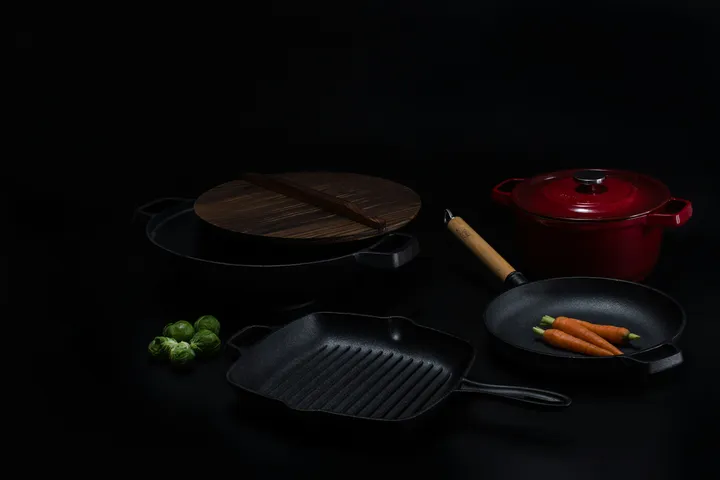
Look inside. A glossy interior (cream, white, a color, or the black satin finish some Le Creuset and Staub pots use) is enamel: a layer of glass fused to the iron. A matte black, slightly textured interior is bare cast iron, protected only by seasoning, which is polymerized oil.
| Enameled dutch oven | Bare cast iron dutch oven | |
|---|---|---|
| Soap | Yes | Yes |
| Soaking | Yes, in warm soapy water | No, it rusts |
| Scrubber | Nylon or natural sponge only | Brush, chainmail, pan scraper |
| Drying | Towel, completely, including the rim | On a burner until bone dry |
| After washing | Nothing | Thin wipe of oil |
| Dishwasher | Allowed, but it dulls the finish | Never |
| Seasoning | Never | Yes |
That table is why generic advice goes wrong. “Soak it overnight” is good advice for a Le Creuset and bad advice for a Lodge bare pot. “Scrub it with chainmail” is the opposite.
Stain, baked-on film, or burnt food?
Run a fingernail across the problem spot.
- Smooth and flat, just discolored: a stain. Long cooks, dark or colorful spices and ingredients, and high heat all leave them, and Lodge says a small amount of staining is expected and does not affect performance. Stains are cosmetic, so treat them last, if at all.
- Slick, slightly sticky, brown to black: baked-on oil. Le Creuset attributes this to fats heated too hot. It is essentially seasoning in the wrong place, and it is the “black bottom” searing leaves behind.
- Rough, raised, crunchy: burnt food. This is the easiest of the three, despite looking the worst.
One cook on Reddit put the common frustration exactly: every guide assumes “chunks that won’t clean off,” but their pot just had “the browned part of the bottom.” That is a stain or a film, not burnt food, and the fix is different.
How to clean an enameled dutch oven
Work from gentlest to strongest and stop as soon as the pot is clean. Each step below is stronger than the last.
Everyday washing
Let the pot cool first. Le Creuset warns never to put a hot pot in cold water or fill a hot pot with cold water, because the thermal shock can crack the enamel. Then wash with warm water, mild dish soap, and a soft nylon sponge or brush, rinse, and dry it completely.
For stuck-on residue, fill the pot with warm soapy water and let it soak. Enamel is glass, so a soak cannot hurt the cooking surface.
Burnt-on food: the baking soda simmer
This is the method to try first on anything scorched. The Kitchn tested five methods (toothpaste, lemon and salt, baking soda with hydrogen peroxide, Bar Keepers Friend, and baking soda with water) on enameled pots with onions deliberately burned onto the bottom. Plain baking soda and water won.
Their method: bring 4 cups of water to a boil, add 2 tablespoons of baking soda, and simmer for a few minutes while scraping the bottom with a wooden spoon. Dump it, rinse, and wash as usual. Le Creuset gives the same idea with 1 to 2 tablespoons simmered for 8 to 10 minutes, and Lodge uses 4 tablespoons in 2 cups for baked-on food. The ratio is not critical. What matters is heat, time, and a wooden spoon instead of metal.
If one round leaves traces, repeat it before reaching for anything stronger.
Brown or black film: Bar Keepers Friend or enamel cleaner
Baked-on oil and gray metal marks from utensils respond to a gentle cleanser. Le Creuset names Bar Keepers Friend, a paste of baking soda and water, and its own enameled cookware cleaner for tough stains, oil residue, and marks. Make a paste, let it sit a few minutes, and work it with a soft sponge.
In The Kitchn’s test, Bar Keepers Friend cleaned the burnt pot completely but needed a second round with the paste left on for about 20 minutes, which is why it lost to the baking soda simmer for burnt food. For oil film, it is the better tool.
Stubborn stains: the bleach soak (safely)
If a stain survives everything above, Lodge’s method for persistent stains on enameled cast iron is to soak the interior for 2 to 3 hours in 3 tablespoons of household bleach per quart of water, then wash with soap and rinse thoroughly.
Use it exactly as written, because the improvised versions are dangerous. The CDC warns that mixing bleach with vinegar or ammonia, or applying heat to it, can generate chlorine and chloramine gases that can severely damage the lungs. So:
- Cool or room-temperature water only. Never simmer or boil bleach in the pot, even though forum threads suggest it as a last resort.
- Never combine it with vinegar. If you tried a vinegar method first, wash and rinse the pot thoroughly before the bleach goes in.
- Stick to Lodge’s dilution. Some guides suggest one part bleach to three parts water overnight, which is more than five times stronger than Lodge’s ratio and left far longer. More bleach is not more cleaning; it is more risk.
- Enamel only. Bleach has no place on bare cast iron.
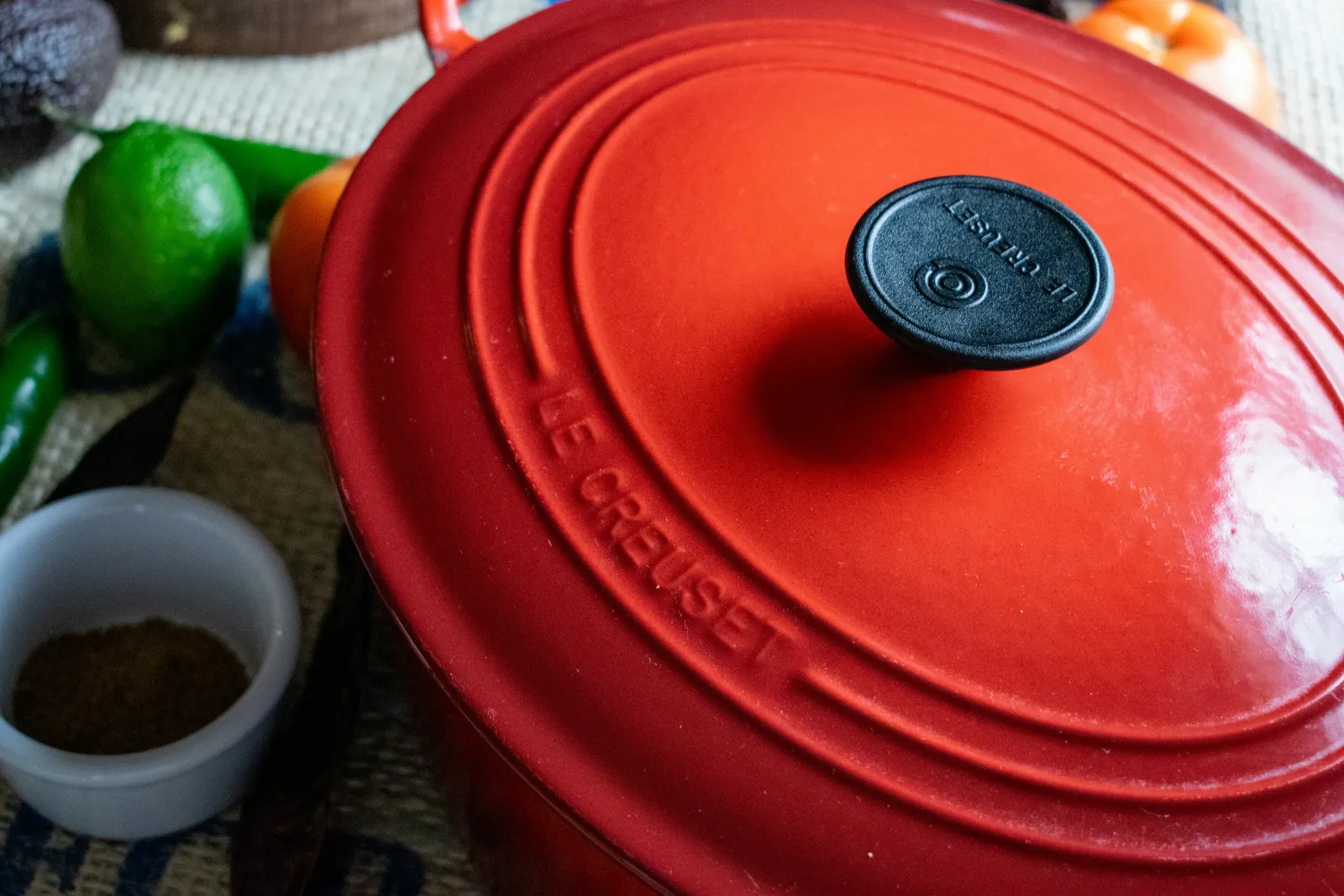
How to clean a Le Creuset dutch oven
A Le Creuset follows the enamel steps above, plus three brand-specific points.
Hand wash it. Le Creuset says its dutch ovens are dishwasher-safe but recommends hand washing, because constant dishwashing can dull the enamel finish over time. It will not hurt cooking performance, but it shows.
Dry the rim. The rim is where an enameled pot can show iron, and “My Le Creuset has gone rusty, is this normal?” is a question Google surfaces for this search. Le Creuset’s care instructions say to rinse thoroughly and dry completely “to prevent the appearance of rust on the rim.” A light rim rust is cosmetic; scrub it gently and dry better next time.
Getting the brown off. The brown film in a well-used Le Creuset is almost always baked-on oil, especially after searing at high heat. Le Creuset’s own advice is to cook on low or medium heat to prevent it. To remove it, work through the ladder: baking soda simmer, then Bar Keepers Friend or Le Creuset’s cleaner, then the bleach soak for whatever stain remains. The same steps apply to a Staub or a Lodge enameled pot; our Lodge vs Le Creuset comparison covers how their enamel holds up to staining and chips.
How to clean a cast iron dutch oven (bare, seasoned)
A bare cast iron dutch oven cleans like a skillet, just bigger. Our cast iron skillet cleaning guide has the full routine and the chemistry behind why soap is fine; here is the pot version.
Everyday washing and drying
- Scrub while it is warm. Hot water, a little dish soap, and a stiff brush or chainmail scrubber.
- Never soak it. Standing water is how bare iron rusts. Wash it and move on.
- Dry it on a burner. Towel it off, then set it over medium-low heat until the last water sizzles away. A dutch oven has far more surface than a skillet, so give it a few minutes rather than the 30 to 60 seconds a skillet needs.
- Oil it thinly. While it is warm, wipe a few drops of neutral oil over the inside and outside with a paper towel, then buff until it looks almost dry.
Burnt-on food in a bare pot
Plain water is enough here: fill the bottom with an inch or two of water, bring it to a simmer for a few minutes, and work the softened food loose with a plastic pan scraper or a wooden spoon. Wash, dry on the burner, and oil.
If you scrape through to gray metal in spots, that is lost seasoning, not damage. Re-season the pot using our dutch oven seasoning guide, or just cook a few fatty meals in it and the spots darken again.
Don’t forget the lid
The lid is where bare dutch ovens rust first. Its underside collects condensation every time you cook, and it often gets a quick rinse while the pot gets the real attention. Wash, dry on the burner, and oil the lid exactly like the pot. Store the pot with the lid ajar or a paper towel between them so moisture cannot get trapped; our cast iron storage guide explains the lid trap.
Cleaning the outside and the lid knob
The exterior of an enameled pot is enamel too, so the same sponge and Bar Keepers Friend handle drips and scorch marks. Go gently around printed logos. Lodge notes that citrus juices and citrus-based cleaners, including some dishwasher detergents, can dull the exterior gloss.
On a bare pot, the outside is seasoned iron. Scrub off drips, dry it with the pot, and include it in the oil wipe so it does not rust where it sits on the burner.
Knobs and handles need checking, not scrubbing. Le Creuset rates its black phenolic knobs to 390°F and its stainless steel knobs to 500°F in the oven. If a phenolic knob looks cracked or loose, tighten or replace it rather than cleaning harder.
Did I ruin my dutch oven?
Almost certainly not. Here is the honest triage:
- Stains, brown film, black bottom, gray marks: cosmetic, and removable with the steps above. Lodge is explicit that staining does not affect performance.
- Rusty rim on enamel: cosmetic exposed iron. Scrub, dry, done.
- Dull exterior: usually dishwasher or citrus. It still cooks the same.
- Chip in the cooking surface of an enameled pot: this is the real end point. Exposed iron rusts and loose enamel should not end up in food. Our cast iron vs enameled dutch oven guide explains why a chipped interior means retiring the pot.
- Rusty or crusty bare cast iron: fixable every time. Scrub it back, re-season, and keep cooking.
What to skip
- Lemon, salt, and citrus cleaners on enamel. The Kitchn tested lemon and salt, and other guides recommend it, but Lodge says citrus dulls the exterior gloss and that damage is not covered by its warranty.
- Steel wool, metal scouring pads, and harsh abrasives on enamel. Le Creuset rules them out; they scratch the glass.
- Heated, strong, or overnight bleach, and bleach after vinegar. Use Lodge’s ratio, cold, for 2 to 3 hours, or don’t use bleach at all.
- Oven cleaner on enamel. No enamel maker approves it, and Le Creuset bans harsh cleaning agents on its pots. Save oven cleaner for stripping bare iron.
- Cold water into a hot pot. Let it cool first. Thermal shock is how enamel cracks.
- Soaking bare cast iron or putting it in the dishwasher. Both strip the oil film and invite rust.
- Seasoning an enameled pot. Oil bakes onto enamel as a sticky residue; enamel never needs seasoning.
- High-heat searing in enamel. Le Creuset recommends low to medium heat for its pots; high heat is what bakes on the black film you end up scrubbing. A heavy pot on medium still sears well.
Frequently asked questions
How do you clean a dutch oven?
First check what it is made of. For an enameled pot (Le Creuset, Staub, Lodge enameled), let it cool, wash with warm soapy water and a nylon sponge, and simmer 1 to 2 tablespoons of baking soda in water to lift burnt-on food. For bare cast iron, scrub with hot water and a little soap, dry it on the stove, and wipe on a thin coat of oil.
How do you clean a badly burnt dutch oven?
For enamel, simmer a few cups of water with 1 to 2 tablespoons of baking soda while scraping with a wooden spoon; The Kitchn tested five methods on scorched pots and this one won. Repeat once if needed, then use Bar Keepers Friend on what remains. For bare cast iron, simmer plain water, scrape with a pan scraper, and re-season any spots you scraped down to gray metal.
Can you use Dawn dish soap on a cast iron dutch oven?
Yes, on both kinds. Enameled cast iron is glass-coated and washes like any dish, and Le Creuset recommends mild dish soap. On bare cast iron, modern dish soap does not strip seasoning; the no-soap rule dates from lye-based soaps. What hurts bare iron is soaking it or leaving it wet, not a squirt of soap.
Can I use Bar Keepers Friend on enamel?
Yes. Le Creuset names Bar Keepers Friend, along with a paste of baking soda and water, for tough stains, oil residue, and metal marks on its enameled dutch ovens. Use it with a soft sponge, not a metal pad, and rinse well. Keep it off the cooking surface of bare seasoned iron, where an acidic, abrasive cleanser works against the seasoning.
How do I get the brown off my Le Creuset?
The brown is usually baked-on oil or a food stain, not damage. Start with a baking soda simmer or a baking soda paste, then Bar Keepers Friend or Le Creuset’s own enamel cleaner for what remains. For a stain that survives all of that, Lodge’s method is a 2 to 3 hour soak in 3 tablespoons of household bleach per quart of cool water. Staining does not affect cooking.
Can you put a dutch oven in the dishwasher?
An enameled dutch oven technically can go in the dishwasher, but Le Creuset and Lodge both recommend hand washing, because repeated dishwasher cycles dull the enamel finish. A bare cast iron dutch oven should never go in the dishwasher: the long soak and harsh detergent strip the oil film and leave it to rust.
Did I ruin my enameled cast iron?
Probably not. Stains, brown film, and gray metal marks are cosmetic and removable, and Lodge says staining does not affect performance. A rusty rim is exposed iron that was left damp; dry it fully after washing. The one real end point is a chip in the cooking surface that exposes iron, which will rust and can shed flakes, so retire that pot from cooking.
How do you clean a rusty dutch oven?
On a bare cast iron dutch oven, scrub the rust off with steel wool or a vinegar soak, wash, dry on the stove, and re-season; our rust guide covers each severity. On an enameled pot, rust only appears where iron is exposed, usually the rim or a chip. Scrub it gently, dry the pot completely after every wash, and the rim stays clean.
Related reading
If you are still choosing a pot, cast iron vs enameled dutch oven lays out the trade-off this cleaning guide keeps running into, and our cast iron dutch oven guide covers sizes and what to cook. The long braises that leave the toughest stains are worth it anyway: try our dutch oven beef stew or pot roast. Bread bakers should line the pot with parchment, as our dutch oven bread method explains, which saves most of the scrubbing. For bare iron, the skillet cleaning routine, the rust removal guide, and how to store cast iron cover the rest of its care.
A dirty dutch oven is rarely a ruined one. Name the pot, name the mess, and start with the gentlest fix that matches both: soap and a soak, then a baking soda simmer, then a gentle cleanser, and bleach only as Lodge prescribes. Most burnt-on messes come out in one round of the baking soda simmer, which The Kitchn timed at 10 to 15 minutes, and the pot is ready for the next braise.