Most cast iron dutch oven bread articles give you one no-knead recipe and call it the whole topic. That works once for a single loaf, but it doesn’t tell you how the steam-trapped crust actually forms, why sourdough wants a different method than no-knead, or why the bottom keeps burning when you scale to longer bakes. This guide covers both methods (the easy 18-hour no-knead, and the sourdough cold-start), explains the steam science nobody else does, and gives you the bottom-burning fix that turns “the bread was almost perfect” into “this is the loaf I’ll bake every week.”
Who this is for
You own a cast iron or enameled dutch oven, ideally a 5 or 6-quart one. You’ve maybe tried no-knead bread once and got mixed results. You want to bake bread that looks like the loaves at the bakery on Saturday morning, and you don’t want to buy a $40 steam oven or pretend a baking stone with ice cubes is going to do it. The dutch oven is the answer. This guide tells you how to use it right.
TL;DR: the three rules
- Match your preheat to your dough. No-knead with a 30 to 45-minute bake: preheat the empty dutch oven to 450°F for 30 minutes. Sourdough with a 45 to 60-minute bake: cold-start the dutch oven (everything goes in together) to avoid bottom-burning.
- Lid on for the first 20 minutes, lid off for the last 15 to 25 minutes. The covered phase traps steam and gives you oven spring. The uncovered phase dries the crust and browns it. Reversing this order or shortening either phase gives you a pale loaf or a flat one.
- Bread flour, not all-purpose. 12% or higher protein content (King Arthur Bread Flour is 12.7%, Bob’s Red Mill Artisan Bread Flour is 12.5%). All-purpose works but gives you a softer crumb and less rise.
That’s the framework. The rest is the why, the two methods in detail, the bottom-burn fix, and the pan-and-flour math.
Why cast iron dutch oven bread gets a better crust than any other home method
Two physics phenomena make a dutch oven the best home-baking vessel for bread.
Steam trapping is the headline. When dough enters a hot oven, it releases water as it heats. In an open pan, that water immediately evaporates into the dry oven and the dough’s surface starts to dry and form a crust within the first 2 to 3 minutes. That early crust formation stops the dough from expanding further, capping oven spring (the dramatic rise that happens in the first 10 to 15 minutes of a bake). With a sealed dutch oven, the released moisture stays inside the pot, keeping the dough’s surface moist for the entire covered phase. The skin doesn’t form until you remove the lid, which gives the loaf 15 to 20 extra minutes of full-volume expansion. Then the lid comes off, the crust dries and browns, and you get the deep crackly shell.
Thermal mass is the supporting act. A 6-quart cast iron dutch oven weighs about 14 pounds. When you preheat it to 450°F, that 14 pounds of iron stores enormous heat. When cold dough drops in, the pot barely loses temperature, the bottom of the loaf hits Maillard browning conditions within 90 seconds, and the steam-rich environment inside the pot still surrounds the rest of the loaf. The same principle that makes cast iron skillet pizza work also makes dutch oven bread work: high emissivity radiates heat to the loaf faster than aluminum or steel.
You don’t need to memorize the chemistry to use the methods below. But knowing what’s happening explains why every step in the procedures matters.
The dough: no-knead vs. sourdough
Two doughs, two different procedures. Both work in the same dutch oven.
No-knead recipe (the 18-hour easy method)
Adapted from Jim Lahey’s foundational technique (the one that started the home no-knead movement in 2006), simplified for a 6-quart dutch oven.
Ingredients:
- 430g bread flour (about 3 1/3 cups; King Arthur or any 12%+ protein flour)
- 8g fine sea salt (1 1/2 teaspoons)
- 1g instant yeast (1/4 teaspoon)
- 345g water (about 1 1/2 cups; room temperature)
Mix and rest:
- Whisk flour, salt, and yeast in a large bowl.
- Add water. Stir with a wooden spoon or your hand until no dry flour remains. It will look shaggy and wet. Don’t knead.
- Cover with plastic wrap or a lid. Let sit at room temperature for 12 to 18 hours. The dough should double, look bubbly on top, and smell faintly yeasty when you pull off the cover.
That’s the whole “kneading” step. Time replaces work; the long rest develops gluten through hydration alone.
Sourdough recipe (the levain method)
Slower, requires a starter, but gives you the deeper flavor of a true artisan loaf.
Ingredients:
- 100g active sourdough starter (fed 4 to 6 hours before, at peak rise)
- 400g bread flour
- 50g whole wheat flour (optional, deepens flavor)
- 9g fine sea salt
- 320g water (room temperature)
Mix and bulk ferment:
- Dissolve starter in water. Add flours and salt. Mix until shaggy.
- Cover and let rest 30 minutes (autolyse).
- Stretch and fold the dough: wet your hand, grab one side of the dough, stretch it up and fold over the middle. Rotate the bowl 90°. Repeat 4 times. That’s one “stretch and fold.” Do 4 sets of stretch-and-folds at 30-minute intervals.
- Cover and let bulk ferment at room temperature for 4 to 8 hours, until the dough has risen 50 to 70% and looks domed and jiggly.
Pre-shape into a round on a lightly floured counter, rest 20 minutes, shape into your final boule, then transfer seam-side-up to a floured banneton or a flour-dusted bowl lined with a clean kitchen towel. Cover and cold-retard in the refrigerator for 12 to 18 hours.
Method 1: no-knead with a preheated dutch oven
Use this method for any dough you’ve rested 12 to 18 hours at room temperature. Bake time is 30 to 45 minutes; the preheat works because the bake is short enough that the bottom doesn’t burn.
- Shape the loaf. Turn the proofed dough onto a heavily floured counter. Fold the edges into the center to form a rough ball. Rest 30 minutes seam-side-down on parchment paper (parchment becomes your transfer sling).
- Preheat the empty dutch oven to 450°F for 30 minutes. Both pot and lid in the oven. Use a lower-middle rack. While preheating, score the loaf with a sharp blade or razor: a single deep cut down the center, or a cross, or a wheat-stalk pattern.
- Transfer the loaf. Pull the hot pot out. Lift the loaf by the parchment corners and lower it (parchment and all) into the dutch oven. The parchment becomes a bake-and-release sling.
- Cover and bake at 450°F for 20 minutes. Lid on. This is the steam phase. Do not open the oven, you’ll release the trapped moisture and crater your oven spring.
- Uncover and bake 15 to 25 minutes more. Drop temperature to 425°F if the crust browns too fast. Pull when the crust is deep golden-brown and an instant-read thermometer in the center reads 200 to 205°F. Internal temperature is the real doneness indicator, not time or crust color alone.
- Lift out by the parchment. Cool on a rack for at least 1 hour before slicing. Bread continues cooking from residual heat for 20 to 30 minutes. Cutting too early gives you a gummy crumb.
Method 2: sourdough with a cold-start dutch oven
The sourdough version of the above, but with the dutch oven going in cold. The 60-minute total bake at room-start gives the loaf time to come up to temperature gradually, which is gentler on the bottom and avoids the burn issue.
- Pull the cold-retarded loaf from the fridge. Don’t let it warm up. Cold dough scores cleaner and holds shape better during the transfer.
- Turn the dough out of its banneton onto parchment, seam-side-down. Score deeply with your blade.
- Place the loaf in a COLD dutch oven on parchment, cover, and put the whole thing in a COLD oven. Set the oven to 500°F. Yes, you’re starting from room temperature. The pot, lid, and dough all heat together.
- Once the oven reads 500°F (typically 12 to 15 minutes for most home ovens), drop to 450°F. Total covered time: 25 minutes from when you set the oven temperature. The dough gets gradual heat with no thermal shock.
- Remove the lid. Bake uncovered at 450°F for 20 to 25 minutes more. Brown should be deep, near-mahogany. Internal temperature target same as no-knead: 200 to 205°F.
- Cool at least 1 hour, ideally 2. Sourdough crumb sets longer than no-knead because of the acidity.
Maurizio Leo at The Perfect Loaf advocates a cold-start approach because the long sourdough bake otherwise burns the bottom. The method above is our version of that principle.
How to keep the bottom of your bread from burning
Cast iron’s thermal mass is mostly your friend, but on long sourdough bakes (60 minutes total) the bottom keeps cooking long after the rest of the loaf is done. The crust goes from golden to mahogany to genuinely burnt. Five fixes, in order of effectiveness:
- Use the cold-start method (Method 2 above). The biggest single fix. A 45-minute total bake from a cold dutch oven cooks the bottom proportionally less than a 60-minute bake in a screaming-hot pot.
- Double the parchment. Use two sheets of parchment between the loaf and the dutch oven bottom. The air gap between the sheets acts as insulation. Trim the excess parchment so it doesn’t catch fire.
- Lower the rack and place an empty baking sheet on the rack below the dutch oven. The sheet absorbs heat radiating up from the oven floor, shielding the dutch oven’s bottom from the most intense heat source.
- Cornmeal or wheat bran layer on the parchment. A tablespoon of coarse cornmeal spread between the parchment and the loaf creates a heat-absorbing layer that takes the worst of the conductive heat instead of the crust.
- Pull the loaf out of the dutch oven for the last 5 to 10 minutes. Lift by the parchment and set the loaf directly on the oven rack. The dutch oven’s heat is now only radiating around the loaf, not conducting through the bottom. Used by serious sourdough bakers for very dark crusts.
Most home bakes only need fix #1 (cold-start). Fixes #2 through #5 stack additively if you’re still over-baking the bottom.
How to score the loaf
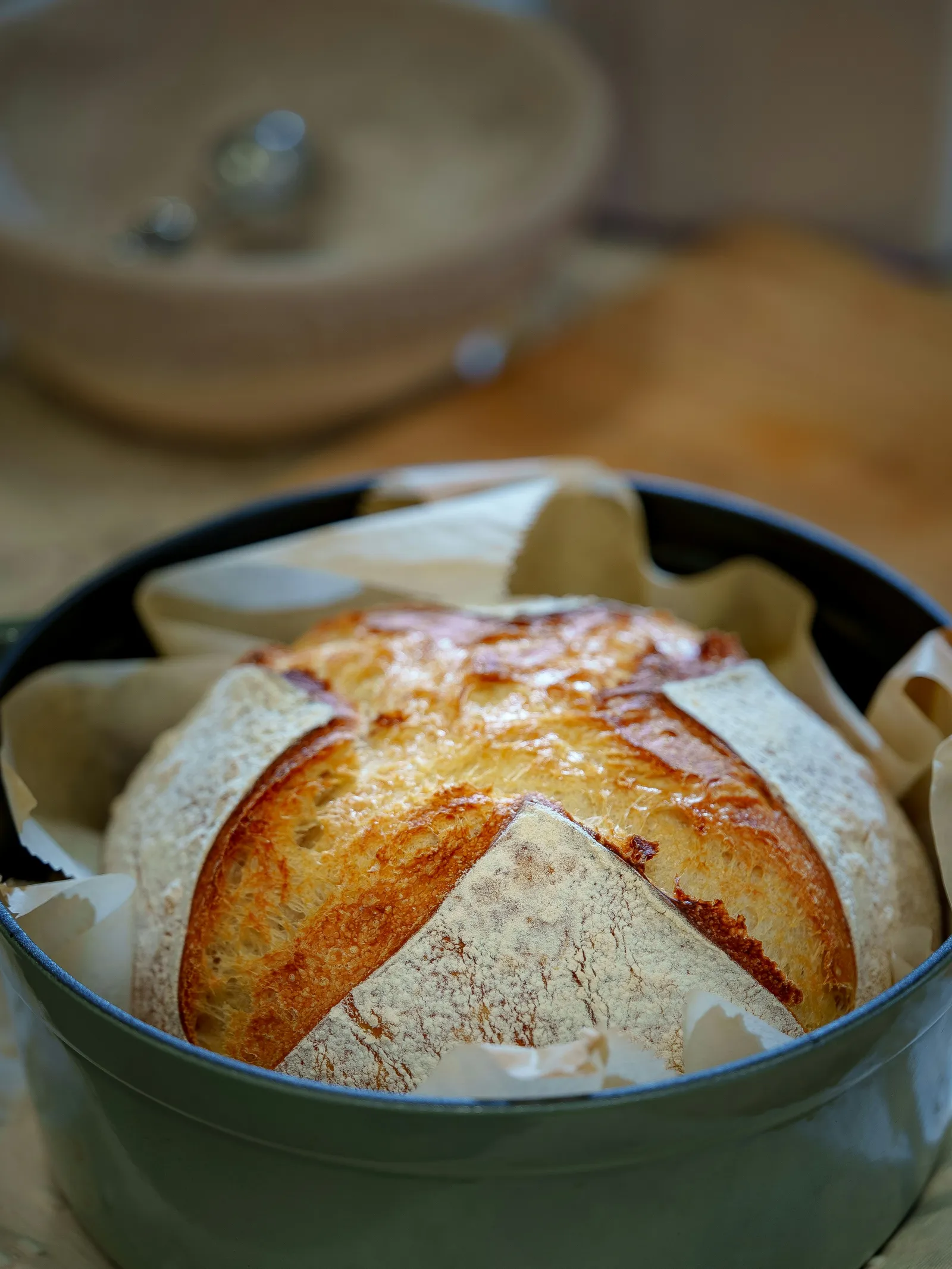
Scoring is the controlled-burst valve for oven spring. Without scoring, the loaf splits unpredictably along weak points in the crust, often blowing out the side instead of the top. With proper scoring, you control where the loaf opens and the result is the bakery-aesthetic “ear” (a raised crust flap where the score caught).
- Use a razor blade, a lame (the dedicated bread-scoring tool), or a very sharp paring knife. Serrated knives drag and tear instead of slicing.
- Score at a 30 to 45° angle to the loaf surface, not straight down. The angle creates the under-crust lip that opens into an ear during oven spring.
- For no-knead loaves, one deep slash down the center (2 cm deep) is enough.
- For sourdough boules, a single curved slash from edge to edge, or the classic cross pattern. The deeper and more confident the cut, the cleaner the spring.
- Score immediately before the loaf goes into the oven. Dough warms and softens; scored too early, the score closes back up.
The best cast iron dutch oven for bread baking
The pan-size math: a 5 to 6-quart round dutch oven fits a standard 600 to 800g flour loaf (about 1.5 pounds finished). Smaller and the dough touches the walls during oven spring, which forces the loaf flat instead of letting it rise tall. Larger and the loaf spreads sideways instead of up. 7-quart and oval shapes are fine for very large or batard-style loaves but unnecessary for the home baker.
Budget pick: Lodge 5 or 6-Quart Bare Cast Iron Dutch Oven (~$60). Same brand as our broader cast iron dutch oven recommendation. Pre-seasoned, rated to any oven temperature, no enamel to worry about. The bare-iron interior darkens further with bread bakes; that’s good. Just use parchment to prevent sticking. If you bought it new, the pre-seasoning is fine for bread immediately, but the long bake is a great opportunity to build up additional seasoning layers on a fresh pot.
Mid pick: Lodge 5 or 6-Quart Enameled Dutch Oven (~$80 to $100). The enamel interior makes cleanup easier and stops the iron from any reaction with very wet doughs. Rated to 500°F. If you’re deciding between the two for more than just bread, our cast iron vs enameled dutch oven comparison covers the full tradeoff.
Splurge pick: Le Creuset 5.5-Quart Round Dutch Oven (~$400). The legendary French enameled dutch oven. The 500°F rating, the lid fit, and the enamel finish are the gold standard. Hand-down-to-your-kid quality. The bread comes out identical to the Lodge version; you’re paying for the finish, the warranty, and the brand.
If you cook bread once a week, the Lodge bare or enameled at 1/4 to 1/6 the price will serve you for life. The Le Creuset isn’t a “better bake,” it’s a better object. Choose based on whether the object matters to you.
For more on bare-vs-enameled trade-offs, see our Dutch oven complete guide.
Troubleshooting
Dough didn’t rise. Yeast was dead (test fresh packet next time), water was too hot at mixing (kills yeast above 130°F), or kitchen was too cold (under 65°F, yeast slows dramatically; let it rise longer or move to a warmer spot).
Loaf came out flat. Under-proofed (push the rise another 2 to 4 hours next time) or under-shaped (the surface tension of a properly shaped loaf is what gives it the upward spring; folding edges into the center should result in a taut “skin”).
Crust didn’t crack open at the score. Score was too shallow (go 2 cm deep, not 5 mm) or dough was too cold and dry (let it warm 15 minutes before scoring next time).
Bottom burned. See the bottom-burn section above. Use cold-start, double parchment, or remove the loaf early.
Loaf stuck to the dutch oven. Skipping parchment was the mistake. Always use parchment. For an enameled pot, never bake without parchment, the dough fuses to the enamel. If you skipped it and now have stuck-on dough residue, our cleaning guide covers the deglazing technique that lifts it off without damaging the pot.
Crumb is gummy. Sliced too early, give it the full 1-hour cool, or under-baked. Use an instant-read thermometer: 200°F is the floor, 205°F is more reliable.
Crust is pale or floppy. Oven was actually cooler than the dial said (verify with an oven thermometer; home ovens often run 25 to 50°F low) or you opened the lid too early during the steam phase.
What to skip
- Preheating an enameled dutch oven empty at 500°F+. Le Creuset and Staub manufacturer warnings apply, the thermal shock can crack the glaze, especially on enamel that’s already aged. Use cold-start for sourdough, or keep enameled preheat at 450°F max for no-knead.
- Baking directly in the dutch oven without parchment. Enameled pots can fuse dough to the surface. Bare cast iron is more forgiving but parchment makes the loaf release perfectly every time. The 50¢ piece of parchment paper is worth it.
- Using all-purpose flour and expecting bread-flour results. All-purpose works, but the crumb is softer and the rise is smaller. For showcase loaves, get bread flour. King Arthur and Bob’s Red Mill are the two standards.
- Skipping the cool. Cutting a hot loaf gives you gummy crumb, even if it’s fully baked. The crumb sets during the cool-down as residual heat finishes the starches.
- Opening the lid before 20 minutes to “check on it.” You lose every bit of trapped steam, and oven spring is over. Set a timer, don’t peek.
- Baking sourdough with a 30-minute preheated empty dutch oven. The bake is too long; the bottom will burn. Use cold-start for any bake over 45 minutes.
- Buying a Le Creuset for bread alone. It’s a beautiful piece of cookware that bakes bread identically to the $60 Lodge version. Don’t let the Le Creuset content on Instagram pressure you into a $400 purchase for one use case.
FAQ
Can you use a cast iron dutch oven to bake bread?
Yes, it’s one of the best home-baking vessels available. The thermal mass holds 450°F+ heat steadily, and the sealed lid traps the moisture released by the dough, creating the steam environment that gives bakery-style oven spring and crust formation. Better than a baking stone with ice for steam, and far cheaper than a steam oven.
Should I oil my cast iron dutch oven before baking bread?
No, use parchment paper instead. Parchment prevents sticking, protects the seasoning (bare iron) or enamel (enameled pots), and acts as a transfer sling for loading and unloading hot dough. Oil works in a pinch on bare cast iron only.
What size dutch oven do I need for bread?
5 to 6 quarts for a standard 600-800g flour loaf (about 1.5 pounds finished). Smaller pots crowd the loaf and force it flat; larger pots let the loaf spread instead of rise. Lodge 5 or 6-quart is the sweet spot for home bakers.
Should I preheat the dutch oven for bread?
For no-knead doughs and short bakes (30 to 45 minutes total), yes, preheat empty to 450°F for 30 minutes before adding the dough. For sourdough doughs and longer bakes (45 to 60 minutes), use the cold-start method (everything goes in cold) to prevent bottom burning.
What are common dutch oven bread mistakes?
Under-proofing, opening the lid early, burning the bottom, choosing a too-small pot, and using all-purpose flour where bread flour is required. Any one of these will downgrade an otherwise good loaf; fix them in order.
Can I bake bread in an enameled dutch oven?
Yes, with two caveats. Check your manufacturer’s maximum temperature rating (most are 500°F; Staub stock plastic knobs are lower, swap for the metal upgrade). Always use parchment paper to prevent the dough from fusing to the enamel.
What this gets you
The first loaf you bake with one of these two methods will be better than 90% of supermarket bread. The third loaf will be better than most bakery loaves outside actual bread cities. After that, you’ll be tinkering with hydration percentages, flour blends, and scoring patterns, the same Saturday-morning ritual every bread baker eventually settles into. The pan does the work the pan is supposed to do: traps steam, holds heat, releases bread. The same cast iron logic that makes skillet pizza and steak work makes bread work. The same pot also handles pot roast and beef stew when you want the dish on the other end of the heat spectrum. One pot, the whole rotation.