Storing cast iron is the most over-thought, under-explained part of owning it. People hang their pans from special racks, agonize over whether stacking will “ruin the seasoning,” and oil them like they are mummifying a pharaoh, while others shove a skillet in a damp cupboard and watch it rust. The truth is simpler than either camp thinks. How you store cast iron comes down to a single variable, and once you understand it, every storage question answers itself.
That variable is moisture. Rust is iron reacting with water and oxygen over time. A bone-dry pan in a dry spot cannot rust, no matter how you shelve it, stack it, or hang it. Everything else, the racks, the oil, the buffers, is detail in service of that one rule.
Who this is for
Anyone who owns one cast iron pan or fifteen and wants them put away without rust, and anyone confused by the conflicting advice online (stack them, never stack them, always oil them, never oil them). It is also for renters and small-kitchen cooks who do not have a wall to drill into or a cabinet to spare, which is the single most common real-world storage problem.
TL;DR: the one rule and the three steps
The rule: keep it dry. A dry pan in a dry place will not rust.
The routine, every time:
- Clean it (see our cast iron cleaning guide for the 60-second method).
- Dry it completely. Towel it, then set it on a burner over medium heat for a minute until the last invisible film of water steams off. This step prevents more rust than anything else you can do.
- Store it dry, wherever is convenient. For long-term storage (weeks or more) or a humid climate, add a barely-there wipe of oil first and store any lid ajar.
That is the whole thing. The rest of this guide is why each step works and how to handle the edge cases.
The only thing that actually matters: moisture
Cast iron is, as one memorable internet comment put it, a big hunk of iron, and you can treat it like a big hunk of iron. The seasoning (a hard, polymerized layer of oil bonded to the metal, explained in our seasoning guide) is a good moisture barrier, but it is not waterproof forever. Leave water sitting on or near bare or thinly-seasoned iron and you get rust, which is just iron oxide.
Rust needs three things: iron (unavoidable), oxygen (unavoidable), and water (the one you control). Remove the water and the reaction stops. This is why a pan stored bone-dry in a kitchen cupboard lasts decades while the same pan stored damp under a sink rusts in a week. The storage location matters because some spots are humidity traps:
- Under the sink: damp from pipes and the occasional leak. A common rust spot.
- Near a dishwasher vent: dishwashers exhaust hot, humid air. Pans stored right beside one collect moisture.
- Damp basements, garages, and unheated sheds: seasonal humidity swings cause condensation on cold metal.
- Sealed in plastic bags or airtight containers while even slightly damp: the worst case, because any residual moisture has nowhere to go and becomes a personal humidity chamber for the pan.
J. Kenji Lopez-Alt makes the same point in his Serious Eats cast iron maintenance guide: the key to keeping cast iron healthy is drying it thoroughly and not letting it sit wet. Storage is just that principle extended over time. Get the pan dry, keep the storage spot dry, and rust never gets a foothold.
Can you stack cast iron pans? Settling the myth
Yes, you can stack cast iron pans. The fear that stacking “ruins the seasoning” is folklore, and it confuses a lot of people who have read both “never stack them” and “just stack them, it is fine” in the same forum thread.
Here is the reality. Seasoning is a hardened, cross-linked polymer bonded to the iron. It is not a fragile nonstick coating that scratches off if another pan touches it. Setting one cast iron pan inside another does not damage that layer. What stacking can do is two minor, cosmetic things:
- Light surface scratches where the rim of one pan grinds against the cooking surface of another, especially if you slide them or the stack vibrates (a pan rack near a busy walkway, for instance). These scratches are cosmetic and season right back over with normal use.
- Crud transfer: if the bottom of an upper pan has any cooking residue or stove grime on it, that can rub off inside the pan below.
Both are solved by a thin buffer between stacked pans:
- A paper towel (the most common fix, and it doubles as a moisture wick for long-term storage).
- A coffee filter, which is what a lot of careful cooks and collectors use because it is thin, clean, and cheap.
- A cork trivet, felt pad, or thin dish towel for heavier pans or larger collections.
If you stack daily-use pans with nothing between them, the worst that happens over years is a slightly scuffed look and a seasoning that is, if anything, well-worn and slick. So stack away. The buffer is optional insurance against scratches and grime, not protection for the seasoning.
The lid trap: why dutch ovens rust in storage
Storing a lidded skillet or a cast iron dutch oven with the lid sealed tightly on creates a closed chamber that rusts the pan from the inside. It is the storage mistake almost nobody warns you about, and the single most useful tip in this guide.
Any trace of moisture left inside, from washing, from humidity in the air, from a pan that was not quite bone-dry, gets trapped and cannot evaporate. Over days and weeks, that trapped humidity condenses and re-condenses on the interior, and you open the pot weeks later to find a ring of orange rust on the inside walls and the underside of the lid. The pan looked clean when you put it away; the sealed lid did the damage.
The fix is simple: store the lid off, ajar, or with a spacer.
- Lid off: store the pot and lid separately if you have the space.
- Lid ajar: rest the lid slightly askew so there is an air gap, or use a folded paper towel or a wine cork between the rim and the lid to hold it open a few millimeters. Airflow is all you need.
- Paper towel inside: a paper towel in the bottom of a stored dutch oven wicks any stray moisture and keeps the interior dry.
This applies to enameled cast iron too (Le Creuset, Staub, and the like). Enameled pots still trap humidity under a sealed lid, and the enamel rims can chip where a heavy lid grinds against the pot, so a buffer between pot and lid does double duty: airflow plus chip protection. Manufacturers ship these pots with a small plastic or rubber lid bumper for exactly this reason; keep it, or improvise one.
If you have ever pulled a dutch oven out of the cabinet before a dinner party and found it rusty despite “doing everything right,” the sealed lid was almost certainly why.
Should you oil cast iron before storing?
Sometimes, and less than you think. A thin film of oil on a stored pan adds a second moisture barrier on top of the seasoning, which is useful insurance for long-term or humid-climate storage. But oil in storage is a Goldilocks problem, and most people overshoot.
When to oil before storing:
- Long-term storage (more than a couple of weeks unused).
- Humid climates or humidity-prone spots (coastal areas, damp basements, summer storage without climate control).
- A pan with thin or new seasoning that needs the extra protection.
When to skip it:
- A well-seasoned pan you cook with every few days. The cooking is the maintenance; an everyday pan does not need a storage coat.
How to do it right: put a few drops of a neutral oil (the same oils we recommend in our best-oil guide, like grapeseed or canola; smoke point does not matter here since you are not heating the pan) on a paper towel, wipe the entire pan inside and out, then wipe it again with a clean towel until it looks dry, not glossy. The goal is a microscopically thin film, not a visible coat.
The mistake to avoid: a thick, visible layer of oil. Excess oil does not stay put in storage. It oxidizes, goes rancid and sticky, and leaves a gummy, varnish-like film you have to scrub off before you can cook. More oil is not more protection; it is a future cleaning project. When in doubt, wipe it back until you think there is almost no oil left, then wipe it once more.
Where to store cast iron: five methods ranked
There is no single best way to store cast iron, only the method that fits your space. Here they are, with honest pros and cons.
| Method | Best for | Watch out for |
|---|---|---|
| In the oven | Small kitchens, one or two pans | Must remove before preheating |
| Hanging | Display, airflow, frequent use | Needs wall studs and anchors for heavy pans |
| Stacked in a cupboard | Compact storage, several pans | Use a buffer between pans |
| Vertical rack or organizer | A growing collection | Takes cabinet or counter footprint |
| In a drawer | Heavy-duty kitchens | Needs full-extension, rated slides |
In the oven (the small-kitchen classic)
Storing your skillet in the oven is the oldest small-kitchen trick there is. It is free, it hides the pan, and the oven is a dry environment. The one rule, and it is non-negotiable: take the pan out before you preheat. Every cast iron owner has either forgotten a skillet in a heating oven or knows someone who has, and at best you get a smoking pan and a startled evening, at worst a damaged handle if anything plastic was resting on it. Build the habit of glancing in the oven before you turn it on. Some people leave an oven mitt on the front handle as a reminder.
Hanging (display and airflow)
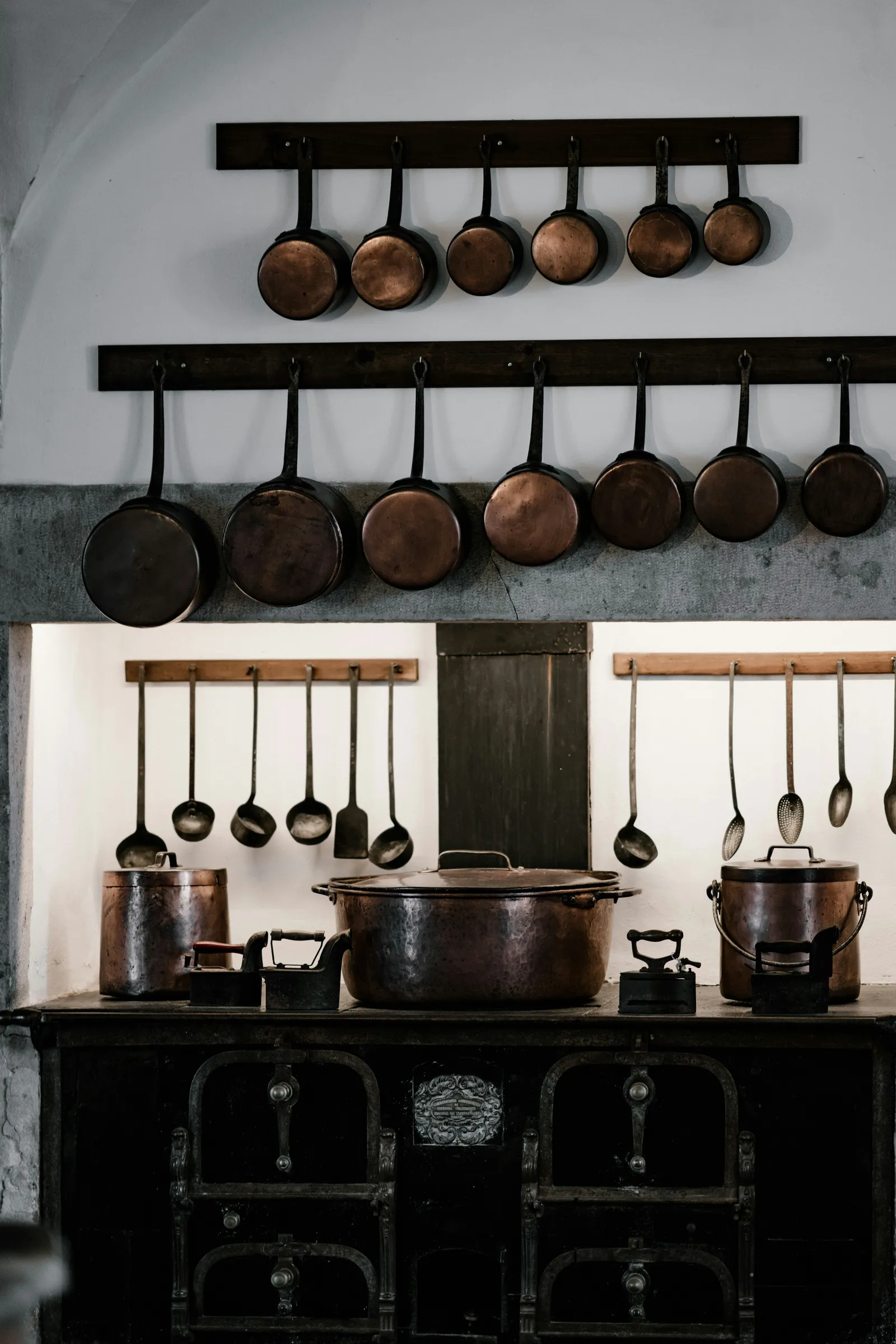
Hanging pans on a wall rail, pot rack, or pegboard gives you the best airflow of any method (nothing traps moisture) and keeps heavy pans off your shelves. The catch is weight: a loaded cast iron skillet is heavy, and a 12-inch pan plus a dutch oven on the same rail adds up fast. Anchor any hanging hardware into wall studs or use heavy-duty toggle anchors rated well above the pan weight. A hook pulling out of drywall with a 10-pound pan on it is a bad day. This is how the manufacturer does it too: Lodge’s own team leans on hanging and pan rails to store their cast iron.
Stacked in a cupboard (compact)
The most space-efficient method for several pans, and perfectly fine as long as you use a buffer (paper towel, coffee filter, or cloth) between pans to prevent scratches and crud transfer. Nest them largest on the bottom. This is what most home cooks do, and it works.
Vertical rack or organizer (best for a collection)
If you own several pans, a vertical pan organizer (the wire kind that holds pans on their edges like records in a crate) keeps each pan separate, dry, and grab-able without unstacking. It takes up cabinet or counter space, but for a growing collection it beats a precarious stack. This is the upgrade once you pass three or four pans.
In a drawer (heavy slides only)
A deep drawer under the cooktop is convenient if, and only if, the drawer slides are rated for the weight. Cast iron is heavy and a drawer full of it will destroy cheap slides over time. Full-extension, heavy-duty rated slides only. Otherwise, stick to a cupboard.
Storing cast iron in a small kitchen or rental
This is the real problem for a lot of people: limited space, no wall to drill into, roommates, and a landlord who does not want holes in the kitchen. You have more options than you think, none of which require a “cool contraption.”
- In the oven is the renter’s best friend: zero footprint, no installation, just remember the preheat rule.
- Stacked in a low cabinet with paper towels between pans is the most space-efficient no-install option.
- A freestanding vertical organizer on a shelf or in a cabinet stores several pans on end without any wall mounting.
- A tension rod or freestanding pot rack gives you hanging storage with no drilling if you want pans visible.
- On the stovetop is legitimate if it is your daily pan. A well-seasoned skillet that lives on the back burner and gets used constantly is being stored and maintained at the same time, as long as your stovetop stays dry (wipe up splashes, and do not store it under a lid that traps moisture). On a glass or ceramic cooktop, the same lift-don’t-slide rule applies to the resident pan.
The OP on a popular cast iron forum thread summed up the renter’s dilemma perfectly: limited shared-kitchen space, no desire to drill the wall, and guilt about stacking on the counter. The honest answer is that stacking is fine (with a buffer), the oven is free real estate, and a $15 freestanding organizer solves the rest. None of it has to be elaborate.
Long-term, seasonal, and camping storage
For pans going into storage for months (a camping dutch oven over winter, a spare skillet, a move), use the full protocol because you will not be around to catch early rust:
- Clean and dry completely, including the stovetop heat-dry step.
- Wipe on a thin layer of oil and buff it back until the pan looks dry (the long-term moisture barrier).
- Put a paper towel inside the pan to wick any stray humidity, and a folded paper towel or cork to hold any lid ajar.
- Store in the driest spot available, ideally a climate-controlled interior closet rather than a garage, basement, or shed where humidity swings.
- Do not seal it in plastic unless you include desiccant; a sealed bag traps humidity. A breathable cover or an open shelf is better. (A padded cast iron storage bag is fine for transport and chip protection, as long as the pan goes in bone-dry and the bag breathes; the problem is sealing moisture in, not the bag itself.)
- Check on it once if it will be stored for many months, so you catch any surface rust early (a light surface bloom wipes off easily; see our rust-rescue guide if it has gone further).
Camping cast iron deserves special care because it lives in exactly the wrong conditions: damp ground, cold nights, humid coolers. Get it fully dry before it goes back in the kit, oil it, and never seal a damp dutch oven in a closed tote.
Storing enameled cast iron and dutch ovens
Enameled cast iron (Le Creuset, Staub, and similar) follows the same lid-off-or-ajar rule from above, but it adds one concern bare cast iron does not have: chip protection. Enamel can chip where a heavy lid grinds against the pot rim, and an exposed chip is bare iron that can rust. Keep the small plastic or rubber lid bumper the pot shipped with, or improvise one with a folded cloth, a couple of wine corks, or a felt pad between the pot and lid. It holds the lid ajar for airflow and protects the rim from grinding at the same time.
The bare cast iron rim of an enameled dutch oven is the part most likely to rust, so a thin wipe of oil on that exposed rim before long-term storage is worth the ten seconds.
What to skip: the storage mistakes that cause rust
Most cast iron storage problems come from a short list of avoidable mistakes:
- Storing it wet, or “air-drying” on a rack. Residual water is the whole problem. Always heat-dry on the stove before storage. Do not let a washed pan drip-dry and call it done.
- Sealing a lid on tight. The humidity trap that rusts dutch ovens from the inside. Lid off or ajar, always.
- Over-oiling. A thick coat goes rancid and gummy. Thin wipe, buffed dry, long-term only.
- Sealing a damp pan in plastic or an airtight container. Creates a humidity chamber. Use breathable storage.
- Storing in a humid spot. Under the sink, by the dishwasher, in a damp basement. Pick the driest location you have.
- Avoiding stacking out of seasoning fear. Stacking is fine; the seasoning does not care. Use a buffer for scratches, not for the seasoning.
- Storing food in the pan. Leftovers, especially anything acidic, sitting in cast iron will strip the seasoning and give food a metallic taste, and left long enough they pit the surface. Transfer food to a container; the pan is for cooking, not storing.
Get those wrong and even a perfectly seasoned pan can rust in the cupboard. Get them right and storage becomes a non-event.
Frequently asked questions
How do you store cast iron when not in use?
Store it completely dry, in a dry spot, and it will not rust. After washing, dry the pan thoroughly (heat it on the stove for a minute to drive off the last of the moisture), then put it wherever is convenient: a cupboard, the oven, hanging, or stacked. For storage longer than a couple of weeks or in a humid place, add a barely-there wipe of oil first. The single rule that matters is that the pan and its storage spot are dry.
Can you stack cast iron pans?
Yes. Stacking does not hurt seasoning, which is a hardened, polymerized layer bonded to the iron, not a delicate coating. The only real risks are minor cosmetic scratches where rims grind together and crud transferring from the bottom of one pan to the inside of another. A paper towel, coffee filter, or thin cloth between stacked pans solves both. The never-stack rule is folklore.
Should you oil cast iron before storing?
Only for long-term storage (weeks or more) or in a humid climate, and only a barely-there amount. A thin wipe of oil buffed until the pan looks dry adds a moisture barrier. Too much oil is the mistake: excess oil goes rancid and sticky in storage and gums the surface. For a well-seasoned pan you use every week, skip the oil and just keep it dry.
How do you store cast iron long term?
Clean it, dry it completely (heat it on the stove to be sure), wipe on a thin layer of oil and buff until it looks dry, then store it in a dry place with airflow. If it has a lid, store the lid off or ajar so moisture cannot get trapped inside. For camping or seasonal storage, a paper towel inside the pan wicks any stray humidity. Check on it once if it is stored for many months.
Why does my cast iron rust in storage?
Almost always one of three things: it went into storage damp, it is stored in a humid spot (under a sink, a damp basement, near a dishwasher vent), or it was put away with the lid sealed on, which traps moisture into a humidity chamber. Rust needs water plus oxygen plus time. Remove the water by drying thoroughly and storing dry, and rust has nothing to work with.
What destroys a cast iron skillet?
Genuine threats are few: prolonged moisture (rust), a sudden severe temperature shock to a cold pan (rare cracking), being dropped on a hard floor, and a self-cleaning oven cycle or oven-cleaner, which strips the seasoning (though that can be rebuilt). Everyday cooking, metal utensils, stacking, soap, and normal high heat do not destroy cast iron. The most common slow killer is storing it wet or in a humid place, which is entirely preventable.
How long does cast iron last?
Effectively forever. Well-kept cast iron is routinely passed down for generations, and pans from the early 1900s still cook fine today (see our vintage cast iron guide). The iron does not wear out, and the seasoning can always be rebuilt. Storage is the main thing that shortens a pan’s life, and only when it is stored wet long enough to rust deeply and pit.
Related reading
Storage is the last step in the cast iron care cycle, and it connects to the rest of it. Before you store a pan, it has to be clean and dry, which is the cast iron cleaning routine. When storage goes wrong and a pan rusts, the fix is in how to clean a rusty cast iron skillet. The reason a well-stored pan shrugs off humidity in the first place is good seasoning, and the thin oil wipe for long-term storage uses the same oils we tested for seasoning. For dutch ovens and the lid trap, see the cast iron dutch oven guide, and if you are storing older or collectible pieces, the vintage cast iron guide covers what those pans need.
Cast iron storage is not a ritual, it is a single rule with a few sensible habits around it. Keep the pan dry, keep the storage spot dry, leave lids ajar, and stack with a paper towel if you like. Do that and the pan you put away today will be exactly as good when you pull it out next month, next year, or hand it to someone in thirty years.