Most guides on how to clean a rusty cast iron skillet treat every pan the same: scrub with steel wool, wash, season. That works for light surface rust, fails on a yard-sale find covered in orange, and is overkill for the two small spots from leaving a pan wet overnight. The right method depends on severity. This is how to diagnose what you’re dealing with, the three methods that actually work (chainmail, vinegar bath, full strip), and the re-seasoning workflow that makes the pan usable again.
TL;DR: pick the method that matches your pan
| Severity | What it looks like | Method | Time |
|---|---|---|---|
| Light | A few small orange spots on the cooking surface | Chainmail + hot soapy water | 5-10 min + reseason |
| Moderate | Orange covering most of the cooking surface; pan still recognizable as cast iron | Vinegar bath (50/50 with water), 30 min to 8 hr | 1-8 hr + reseason |
| Severe | Pan looks like rust with a pan shape under it; yard-sale or barn find | Strip with steel wool or oven cleaner back to bare gray iron | 1-3 hr + reseason |
After any of the three methods, the pan needs a full 4-round seasoning bake before you can cook on it. See our seasoning method for the step-by-step, or the re-seasoning diagnostic if the seasoning is salvageable and you only need a partial fix. The rust removal is the easy part; the seasoning rebuild is the slow part.
Why cast iron rusts (the chemistry in 60 seconds)
Rust is iron oxide, formed when iron contacts water and oxygen. Cast iron is more rust-prone than most metals because the surface is porous and holds moisture, and because seasoning (the polymerized oil layer that’s supposed to be there) is the only barrier between the iron and the kitchen atmosphere. When seasoning is thin, broken, or absent, water and oxygen reach the bare iron and the chemistry happens fast: in a humid kitchen, a wet pan can start showing rust within hours.
The good news: rust on cast iron is almost always cosmetic damage that scrubs off. The underlying iron is fine. The only permanent damage would be a cracked pan, which is rare and unrelated to rust (it requires putting a hot pan into cold water, which thermal-shocks the metal). Everything else, from a few spots to a totally orange pan, is fixable.
The prevention is the routine cleaning method: dry the pan completely on the stovetop after every wash, then wipe with a tiny amount of oil. Skip either step often enough and you’re back here.
Diagnose your rust: light, moderate, severe
Before you scrub anything, look at the pan and decide which of three categories it falls into. The method changes substantially.
Light surface rust. A few orange spots, usually on the cooking surface, often the result of leaving the pan damp once or storing it in a humid spot for a few weeks. The rust wipes off with a fingertip. The rest of the pan still has visible seasoning (dark brown to black, slightly slick).
Moderate rust. Orange covers most or all of the cooking surface. The pan still looks like a cast iron pan, but the seasoning has clearly broken down. You probably left this pan in a sink full of water for hours, or stored it wet for months. Underneath the rust is still mostly intact seasoning that can be saved.
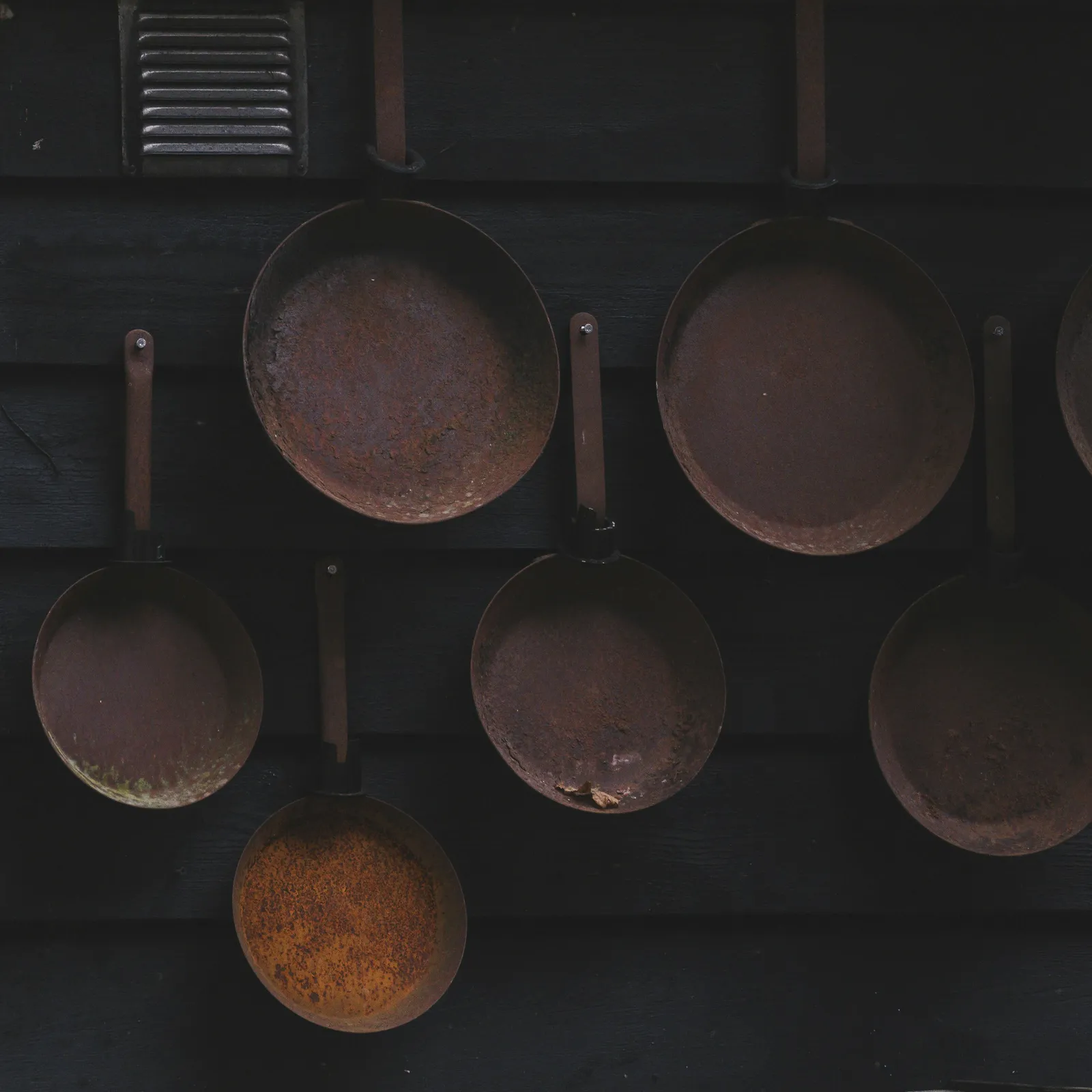
Severe rust. The pan looks like an artifact. Rust covers the inside, outside, handle, and underside. You picked it up at a yard sale, a barn, an estate auction, or it sat in your garage for five years. There may be flaking, pitting, or chunks of rust falling off. The seasoning underneath is gone; you’re starting from bare iron. If the rusted pan is a vintage Griswold or Wagner find, this category is where most are when you bring them home; don’t let the rust scare you off a $200 pan.
The methods below correspond to the three categories. Don’t try to vinegar-bath a pan with two small spots, and don’t try to chainmail your way through a fully-encrusted yard-sale find. Pick the right tool.
Method 1: chainmail + soap (for light surface rust)
For light rust, this is the entire job. About 10 minutes from start to dry pan.
You need: a chainmail scrubber (~$15), hot water, dish soap, a kitchen towel. You probably already have all of it.
The method:
- Fill the pan with hot water and a few drops of dish soap. Let it sit for 2-3 minutes while the water softens the rust.
- Scrub the rust spots with the chainmail in firm circular motions. The rust will come off in a brown-orange slurry. Keep going until the spots are gone and the underlying metal is visible.
- If small bits of rust remain after the chainmail, finish with fine (000 or 0000) steel wool for 30 seconds per spot. Steel wool removes seasoning along with rust, so use it sparingly.
- Wash the pan with more soap and water, rinse thoroughly, and pat dry with a towel.
- Set the pan on the stovetop over medium heat for 60 seconds to evaporate the last moisture. Listen for the hiss to stop.
- Wipe the pan inside and out with a paper towel and 1/4 teaspoon of neutral oil while still warm.
You’re done. The pan is usable for cooking immediately. The spots where you scrubbed will be slightly lighter than the rest of the pan; that’s the seasoning underneath showing through, and it darkens back to match within 3-5 normal cooking uses.
This method also works for the small rust patches that appear over time on the underside of a well-used pan. Don’t aim for “back to bare iron”; just remove the active rust and re-oil.
Method 2: vinegar bath (for moderate rust)
When chainmail alone isn’t going to win in 10 minutes, the vinegar bath is the next escalation. Cheap, effective, and as long as you respect the timing, won’t damage the pan.
You need: white vinegar (1-2 gallons, ~$3 each), water, a sink or large plastic tub, the same chainmail and steel wool as method 1.
Why vinegar works: acetic acid dissolves iron oxide. A 50/50 solution is mild enough to be safe on cast iron for a few hours but strong enough to remove rust without aggressive scrubbing. Stronger concentrations work faster but escalate the risk of over-etching the bare iron underneath the rust.
Step-by-step
- Mix equal parts white vinegar and water, enough to fully submerge the pan. For a 10-inch skillet, that’s typically 1-2 gallons.
- Submerge the pan completely. If you only have rust on the inside, you can fill the pan with the solution and leave the outside dry, but doing the whole pan is easier and ensures even rust removal.
- Set a timer for 30 minutes and check every hour after. The rust will bubble off in flakes; you’ll see orange staining the solution.
- When the visible rust is mostly gone (usually 1-4 hours for moderate rust, up to 8 hours for severe), remove the pan, rinse immediately with hot water, and scrub with chainmail to remove any loosened residue.
- Wash thoroughly with soap and water to neutralize any remaining acid.
- Dry on the stovetop over medium heat for 60-90 seconds (longer than usual; the pan absorbed water during the soak).
- Move directly to the full re-seasoning workflow below. A pan that’s just been vinegar-bathed is bare or nearly-bare iron and will rust again within hours if you don’t seal it with oil and bake.
How long is too long (the over-etch warning)
The vinegar bath has a hard time limit: about 8 hours. Past that, with the rust gone, the vinegar starts attacking the bare iron underneath. The visible signs of over-etching: the surface develops a frosted, matte-gray look (instead of the bright silver-gray of fresh iron); small pits form where the rust was deepest; the surface feels rough.
Light over-etching is cosmetic and seasons over within 10-15 uses. Heavy over-etching is permanent. To avoid it: never leave the pan in vinegar overnight, never use undiluted vinegar, and check the pan every 60-90 minutes after the first 30 minutes. When the rust is gone, get the pan out immediately.
If you over-etch a pan, the fix is the same as any restoration: full strip back to bare iron, then 4 rounds of seasoning. The pits won’t disappear but they fill in cosmetically with seasoning over time.
Method 3: full strip and reseason (for severe rust or yard-sale finds)
This is the workflow for a pan that’s beyond rescue with surface methods. A yard-sale find covered in rust, a pan that sat in a damp basement for five years, anything where the rust is the dominant feature. The plan is to take the pan all the way back to bare gray iron, then build seasoning from scratch.
Option A: strip with coarse steel wool
The least-aggressive of the strip methods, but it works on most pans.
- Put the pan in the sink. Add hot water and dish soap.
- Use coarse (0 or #0) steel wool to scrub every surface aggressively, including underside, sides, and handle. Pour out the rust slurry and refill the sink as needed.
- Keep going until the pan is uniformly gray. This usually takes 30-60 minutes of solid scrubbing and is genuinely the worst part of the process. Wear gloves; the slurry stains skin and clothing.
- Wash with soap, rinse, dry completely on the stovetop, and move to re-seasoning.
This method works on most yard-sale pans but is slow for fully-encrusted finds. If you’re 20 minutes in and not making visible progress, escalate to option B.
Option B: oven cleaner
Oven cleaner (Easy-Off, Mr. Muscle, etc.) contains sodium hydroxide (the modern equivalent of lye), which dissolves both rust and old seasoning aggressively. Faster than steel wool by an order of magnitude, but with safety caveats.
- Outdoors or in a very well-ventilated space, put the pan in a heavy-duty trash bag.
- Spray the entire pan with oven cleaner. Heavy coat, every surface.
- Seal the bag and let it sit for 24-48 hours.
- Open the bag (in the same well-ventilated space), pour out the slurry, and rinse the pan thoroughly with water. Wear nitrile gloves and eye protection. The slurry is caustic.
- Scrub with steel wool to remove any remaining residue.
- Wash with soap, rinse repeatedly to neutralize any remaining caustic, dry on the stovetop, and move to re-seasoning.
The oven cleaner method is the fastest but it’s also the harshest. Don’t do this with the pan inside the house, and don’t do it with anyone with respiratory sensitivity nearby.
Option C: electrolysis (advanced)
Electrolysis is how cast iron collectors restore valuable antique pans (Griswold, Wagner, etc.) without removing any of the original casting marks. It’s the gentlest and most thorough method, but requires a DC power supply (a battery charger works) and basic safety knowledge around electricity and water. Worth learning if you’re seriously into cast iron collecting; overkill for a Lodge.
The short version: submerge the pan in a tub of water with washing soda dissolved in it, attach the positive lead to a sacrificial steel anode (a piece of rebar or scrap steel), attach the negative lead to the cast iron pan, run 6-12 volts of DC current for 6-24 hours. The rust transfers from your pan to the sacrificial anode through the electrolyte solution. The pan comes out clean without any abrasion.
If you’re interested, search “cast iron electrolysis setup” on the cast iron enthusiast forums for step-by-step builds with photos. For a single pan, vinegar or steel wool is simpler.
After the rust: the full re-seasoning workflow
Any of the three methods above leaves you with a pan that’s clean but completely unprotected. Bare or near-bare iron will start to rust again within hours in a humid kitchen. You have to immediately move to seasoning.
The method:
- Apply a half-teaspoon of neutral oil (grapeseed, canola, or vegetable; see our best-oil writeup for why) over every surface of the pan.
- Buff almost all of it off with a clean paper towel. The pan should look almost dry.
- Bake upside down at 450°F for 1 hour, with foil on the rack below to catch drips.
- Cool in the oven.
- Repeat 3-4 times.
That’s the same method we use for a new pan from the box. Full step-by-step, chemistry, and troubleshooting for what to do if the seasoning comes out sticky or splotchy is in our seasoning guide. For a recently-stripped pan, do all 4 rounds in one afternoon. By the end, the pan is darker than when you started (compared to bare iron) and ready to cook on.
After the four rounds, treat the pan like new cast iron: cook with fat for the first few uses (eggs in butter, bacon, smashed potatoes in oil), wash gently, and apply the daily wipe per the cleaning routine. The seasoning builds quickly from there.
What to skip
Five recommendations that look reasonable and aren’t.
- Lodge Rust Eraser ($7-9). It’s a piece of pumice in branded packaging. A $2 pumice stone from a hardware store does the exact same job. Skip the upsell.
- Coca-Cola or other soft drinks as a rust remover. Works, but slowly, expensively, and leaves a sticky sugar residue you then have to clean off. Vinegar is faster and doesn’t leave a mess.
- Muriatic acid (hydrochloric acid). Some online guides recommend strong acids for severe rust. They work, but they eat into the bare iron underneath alarmingly fast and the safety risk is real. Vinegar is gentler, cheaper, and more forgiving.
- The dishwasher. Some people think running a rusty pan through the dishwasher will help “clean it up.” It accelerates rust formation, doesn’t remove existing rust, and strips any remaining seasoning. Don’t.
- Steel wool on a pan with intact seasoning. Only use coarse steel wool when you’ve already decided to strip the pan. Using it on a pan with light surface rust will remove the rust and the surrounding seasoning, doubling your re-seasoning workload.
Frequently asked questions
What is the easiest way to remove rust from a cast iron skillet? For light surface rust, chainmail + hot soapy water (10 minutes). For moderate rust, vinegar bath 50/50 with water for 30 min to 8 hr. For severe rust, full strip with steel wool or oven cleaner. Then re-season 4 rounds.
Does vinegar and baking soda remove rust from cast iron? Vinegar does the work. Baking soda is mostly cosmetic in the combination. 50/50 white vinegar and water dissolves iron oxide; don’t leave the pan in longer than 8 hours.
Can a rusty cast iron skillet be saved? Almost always. Cast iron is genuinely hard to ruin permanently. Only a structural crack (rare) is unsalvageable.
What’s the best rust remover for cast iron? White vinegar diluted 50/50 with water. $3/gallon, you already have it. Specialty rust removers (Evapo-Rust, Lodge Rust Eraser) are unnecessary for home use.
What should you not clean cast iron with? Avoid: the dishwasher, abrasive scouring powders, bleach, prolonged water soaks, undiluted vinegar, muriatic acid, and the dishwasher again because it’s worth saying twice.
Can a badly rusted skillet be saved? Yes. Strip with steel wool or oven cleaner, wash, dry, then 4 rounds of seasoning at 450°F. Half a day of mostly-passive work.
How long should I soak a cast iron pan in vinegar? 30 minutes to 8 hours depending on severity. Check every hour after the first 30 minutes. Past 8 hours, the vinegar will etch the bare iron underneath the rust.
Should I use a potato to remove rust from cast iron? For very light surface rust, sure. Cut a potato, dip the cut side in coarse salt, scrub. Oxalic acid in the potato + salt abrasion = slow but satisfying. For anything beyond a few spots, vinegar or chainmail is faster.
Related reading
- How to season a cast iron skillet, the full re-seasoning method that follows any rust removal.
- Best oil for seasoning a cast iron skillet, the oil to use for the post-rust re-season (grapeseed or canola, not olive).
- How to clean a cast iron skillet, the daily routine that prevents rust in the first place.
A rusted cast iron pan looks like a disaster and is mostly an afternoon of work. With the right method for the severity, even the worst yard-sale find is back in service by dinner. The harder problem is keeping it from rusting again, which is the cleaning routine plus storing the pan dry, not anything specific to rust rescue.