Most cast iron articles tell you eggs stick because your pan needs more seasoning. They’re wrong. Eggs stick because the pan is the wrong temperature, and almost every “I can’t cook eggs in cast iron” story is a heat-control problem dressed up as a seasoning problem. This guide covers the chemistry of why eggs bond to iron, the four egg styles you’d actually make (fried, scrambled, baked, basted), the after-bacon bonus method, and the pan that makes the whole thing easier. No stopwatch timing, no folklore.
Who this is for
You own a cast iron skillet, probably a Lodge, and you’ve tried eggs in it at least once. They stuck. You scraped the pan, read a Reddit thread, and started believing you need a special technique or a more expensive pan. You don’t. You need to understand how heat moves through iron, why egg protein behaves the way it does, and which two variables actually matter.
TL;DR: the four rules for eggs in cast iron
- Preheat the dry pan for 3 to 5 minutes on medium-low. Not screaming hot, not lukewarm. A drop of water should evaporate in 2 to 3 seconds.
- Add enough fat. A tablespoon of butter for two eggs is the floor, not the ceiling. Real fat, not cooking spray.
- Turn the heat down the moment eggs go in. Cast iron holds heat. The burner’s job is mostly done once the pan is warm; eggs cook on a hot pan over a low burner, not the other way around.
- Wait longer than feels right before moving the eggs. 30 to 45 seconds at minimum. The protein has to set against the fat layer before it’ll release; rushed eggs tear.
That’s the whole method. Everything below is the why, the four egg styles, and what to skip.
Why eggs stick to cast iron (and it’s not your seasoning)
Egg whites are about 11% protein, mostly ovalbumin and conalbumin, plus sulfur compounds that come from cysteine and methionine. When you heat egg protein directly against bare iron above roughly 250°F, the sulfur bonds chemically to the iron surface and the protein denatures into that bond. It’s the same reaction that fuses an egg white to a stainless pan that’s too hot. Serious Eats’ canonical cast iron care guide actually defines a properly seasoned pan as “nonstick enough to cook eggs in”, which is the cleanest practical test there is.
Your seasoning layer is a thin film of polymerized oil that sits between the iron and the food. It works by being a physical barrier, not a magic non-stick coating. When the pan is properly preheated and there’s a layer of fat between the eggs and the seasoning, the egg cooks on the fat, never touches the iron, and lifts cleanly. When the pan is too hot, the fat smokes off in seconds and the egg lands on bare seasoning that’s been overheated and partially carbonized; the bond forms. When the pan is too cool, the fat doesn’t form a continuous film and the protein still finds patches of bare iron to grab.
Heat control is the entire answer. A well-seasoned pan that’s the wrong temperature will still stick. A medium-seasoned pan at the right temperature will release cleanly. If you want the full primer on what seasoning actually is, the seasoning chemistry pillar covers polymerization in detail.
How to fry an egg in a cast iron skillet
This is the method 90% of egg searches are looking for.
- Preheat the dry pan on medium-low for 3 to 5 minutes. Don’t add oil yet. The pan should feel hot when you hold your palm 4 inches above it, and a drop of water should sizzle and evaporate in 2 to 3 seconds (not vanish instantly; that’s too hot).
- Add 1 tablespoon of butter or fat per two eggs. Butter foams as it heats. Wait until the foaming slows but the butter hasn’t browned. Bacon fat, ghee, or a high-smoke-point oil like grapeseed all work. Olive oil is fine for eggs (the smoke point isn’t an issue at this temperature), just expect a slight olive flavor.
- Crack the eggs directly into the pan and immediately turn the heat to low. The pan has enough thermal mass to cook the eggs from this point on; the burner’s job is to hold the floor temperature, not to drive the cook.
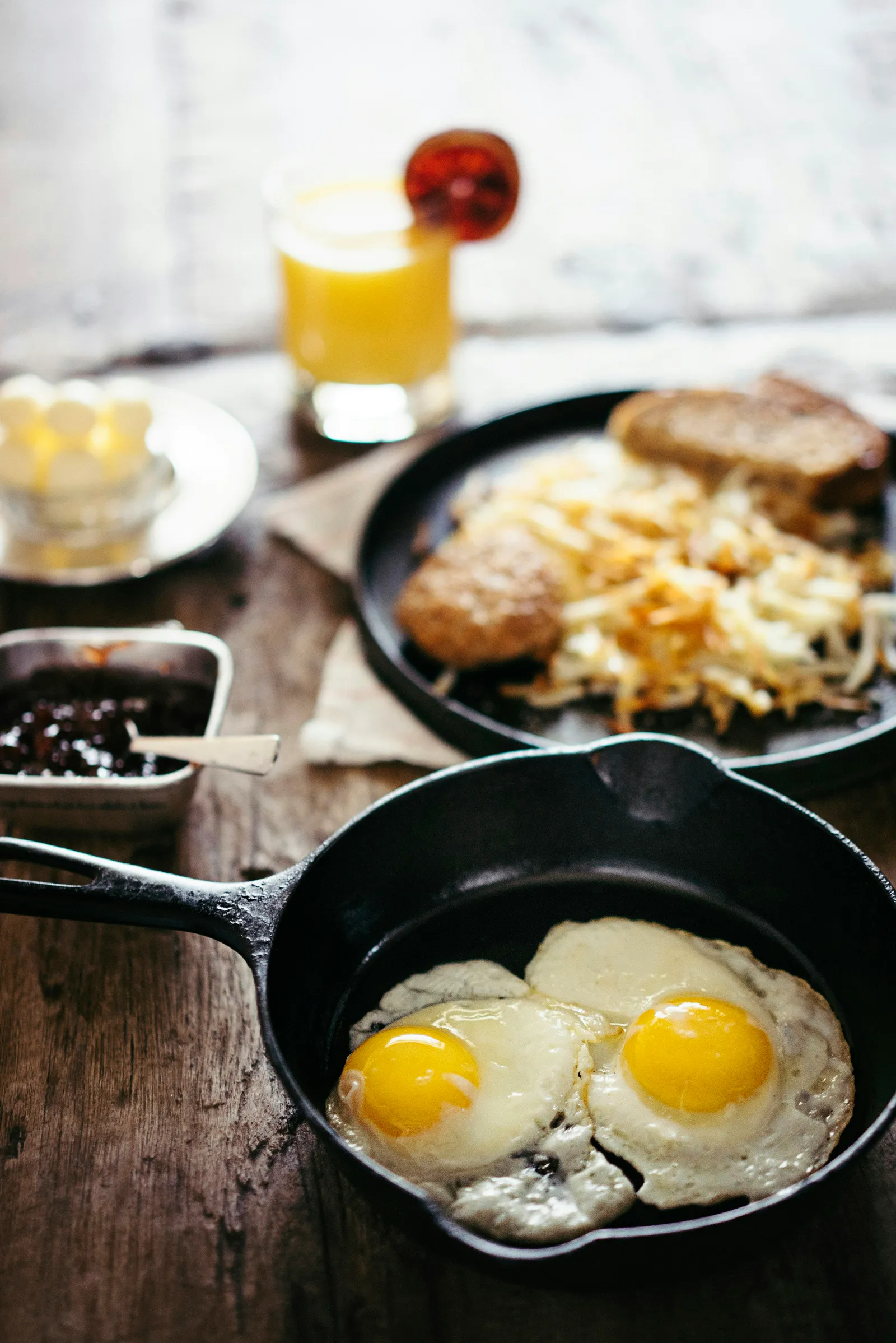
- Don’t touch the eggs for 30 to 45 seconds. Watch the whites set from the edges inward. When the whites are mostly opaque but the centers are still glossy, the eggs will release if you slide a thin spatula under them.
- Decide your finish. Sunny-side up means leaving them; over-easy means a flip; over-medium means a flip plus 15 to 30 more seconds.
Sunny-side up
Cook the eggs at low heat until the whites are fully set but the yolks are still completely glossy and runny. To cook the tops of the whites without flipping, cover the pan with a lid for the last 30 seconds; the trapped steam sets the white from above without touching the yolk. Total cook time: about 2.5 to 3 minutes from when the eggs hit the pan.
Over-easy and over-medium
Slide a thin fish spatula under each egg once the whites are set, flip in one smooth motion, and cook for 15 seconds (over-easy, yolk still fully liquid) or 30 to 45 seconds (over-medium, yolk thickened but not solid) on the second side. The flip works on cast iron, but only because you preheated and used enough fat; rushed flips on a cold pan are how eggs end up scrambled.
Over-hard
Flip and cook another 90 seconds to 2 minutes until the yolk is fully set. You can also break the yolk after flipping to speed this up.
How to scramble eggs in a cast iron skillet
Scrambled eggs are the hardest cast iron egg style because the surface area in contact with the pan is maximum and you’re stirring constantly, which means every part of the egg touches the iron at some point. The fix is fat and patience.
- Beat 3 eggs with a fork until uniformly yellow, no streaks. A tablespoon of milk or cream is optional; it slows the cook and makes the curds softer.
- Preheat the pan on medium-low for 4 to 5 minutes. Slightly longer than for fried eggs because you want very even heat across the surface.
- Add 2 tablespoons of butter (yes, twice what you’d use for fried eggs; the surface area is much higher). Let it foam and stop foaming.
- Pour the eggs in, immediately drop the heat to low, and wait. Don’t stir for the first 30 seconds.
- Stir slowly with a silicone spatula every 20 to 30 seconds, pulling cooked edges toward the center and tilting the pan to let raw egg flow into the gaps. The goal is large, soft curds, not the small scramble you get on a nonstick at higher heat.
- Pull the pan off the heat when the eggs still look slightly underdone. Cast iron’s residual heat will finish them on the way to the plate. Eggs that look perfect in the pan are overcooked by the time you eat them.
The total cook for scrambled eggs in cast iron is 4 to 6 minutes, roughly twice as long as a nonstick. That’s the right pace.
How to bake eggs in a cast iron skillet
Baked eggs (sometimes called shirred eggs) are the easiest cast iron egg method because the oven does the heat-control work for you. The pan goes in at temperature, the eggs cook through gentle ambient heat, and there’s no sticking risk because the eggs barely move.
- Preheat the oven to 375°F with the cast iron skillet inside for 10 minutes. You want the pan and the oven at temperature.
- Pull the pan, add a tablespoon of butter and a tablespoon of cream, swirl to coat. The cream creates a steam barrier between the eggs and the iron.
- Crack 2 to 4 eggs directly into the pan. Salt and pepper on top.
- Return to the oven for 8 to 11 minutes. 8 minutes for runny yolks, 11 for set. Add a tablespoon of grated parmesan or a handful of spinach in the last 2 minutes if you want.
This is the move when you’re cooking eggs for more than two people; you don’t have to babysit individual cracks.
Cooking eggs in cast iron after bacon (the bonus method)
This is the easiest eggs-in-cast-iron technique that exists and almost nobody on page 1 of Google mentions it specifically.
Cook your bacon first (start in a cold pan, follow the basic skillet method for medium-low heat control), pull the bacon out, and leave 2 to 3 tablespoons of bacon fat in the pan. The fat has already coated every micro-pore of the seasoning, the pan is at temperature, and the bacon fat itself acts as the perfect heat-stable cooking medium with a smoke point around 375°F.
Drop the heat to low. Crack the eggs directly into the bacon fat. They’ll release with almost no effort because you’ve solved every variable at once: pan temperature, fat coverage, seasoning protection. This is why cast-iron-cookers tell you to “just cook bacon first” when you ask about eggs.
Troubleshooting: my eggs stuck, now what?
If the eggs are already stuck and you’re staring at the mess:
- Don’t scrape with metal yet. Add water (a few tablespoons) to the still-warm pan and let it sit for 90 seconds. The water lifts most stuck protein.
- Use a wood or plastic scraper to loosen the rest. If anything is still bonded, fall back to the chainmail-scrubber method from the cleaning guide.
- Don’t strip and re-season the whole pan. Stuck eggs don’t damage seasoning; they just leave egg behind. Clean, dry, oil lightly, move on.
For the next attempt, change exactly one variable: increase the fat. If that doesn’t fix it, decrease the heat. The seasoning is almost never the problem.
Cleaning cast iron after eggs
The 60-second routine: rinse the still-warm pan under hot water, scrub with a non-scratch sponge or chainmail if anything’s stuck, dry on the stovetop on low heat for 60 seconds, rub a few drops of oil over the cooking surface with a paper towel, done. Soap is fine; the soap-myth was real in 1950 (lye-based soaps) and false now (the cleaning pillar covers this in detail). If eggs are still stuck after the rinse, deglaze with a splash of water on warm pan, then scrub.
What to skip
- Cooking spray (Pam, etc.) on cast iron. The propellants and lecithin polymerize into a gummy, splotchy layer that you can’t season over. Use real butter, real oil, real bacon fat.
- The $25 silicone egg ring. Get a perfect circle by cracking the egg into a wide ring of bacon fat instead of buying a tool. If you really want round eggs, a stainless biscuit cutter is $4.
- Microwaving the pan to dry it after washing. People do this. Don’t. Stovetop dry on low heat for 60 seconds is faster and won’t risk thermal-shocking the pan.
- Buying a smoother, more expensive pan because eggs stick. A $230 Stargazer doesn’t fix a heat-control problem; it makes it worse, because the lighter pan responds faster to burner changes and gives you less of the thermal-mass buffer that makes eggs work.
- Pre-heating the pan with oil already in it. Pour oil into a cold pan and most of it polymerizes onto the seasoning before the pan’s hot enough to cook in. Preheat dry, then add fat.
- Cooking eggs at medium-high or high heat “to make them faster.” This is the single most common cast iron mistake. Eggs at high heat in cast iron are how the bonding reaction wins. Slow down.
The best cast iron skillet for eggs
A 10.25-inch Lodge Classic ($30, Lodge’s classic skillet page or any hardware store). The Lodge wins for eggs because it’s heavy, which gives it high thermal mass and a steady low-heat floor that’s hard to overheat. Lighter, smoother pans like Stargazer and Field are responsive in a way that feels modern but actually makes eggs harder; they cool faster between burner adjustments, so the floor temperature wanders. For eggs, you want a pan that’s stubborn about temperature, not one that follows the burner.
A second pan worth owning: a 5 to 8-inch mini Lodge ($15 to $20) for single-serving eggs. The smaller pan needs less fat, fits a single egg perfectly, and lives on your stovetop without taking over the burner. It’s the closest thing to a dedicated egg pan in cast iron.
If you’re choosing between cast iron and a Dutch oven for eggs, the skillet wins for everything except baked eggs for a crowd.
FAQ
Can you cook eggs in a cast iron skillet?
Yes, and well. The “don’t use cast iron for eggs” advice is a holdover from people who tried it once with too little oil on a too-hot pan. With proper preheat, enough fat, and low burner heat after the eggs go in, cast iron cooks eggs as cleanly as any nonstick and lets you finish under the broiler if you want.
Is cast iron good for eggs?
It’s good for eggs once you’ve got heat control down. Cast iron’s biggest advantage for eggs is steady low heat: the pan’s thermal mass holds 200 to 250°F evenly across the surface, which is the right temperature for eggs and the hardest temperature to maintain on a nonstick (nonstick pans lose heat fast). The disadvantage is the learning curve.
How long do you cook eggs in a cast iron skillet?
Sunny-side up: 2.5 to 3 minutes. Over-easy: 3 to 3.5 minutes total. Over-medium: 3.5 to 4 minutes. Over-hard: 4.5 to 5 minutes. Scrambled: 4 to 6 minutes. Baked: 8 to 11 minutes in a 375°F oven. Time isn’t the variable to focus on; visual cues (whites fully set, edges crisping) are more reliable.
What is the 5-5-5 rule for eggs?
That’s the Instant Pot hard-boiled egg method (5 minutes pressure, 5 minutes natural release, 5 minutes ice bath). It has nothing to do with cast iron and won’t help you here.
Do eggs stick to seasoned cast iron?
They shouldn’t if the pan is preheated correctly and there’s enough fat. If a well-seasoned pan is still sticking, the problem is heat (too hot or too cold) or fat coverage (too little), not the seasoning itself.
What this gets you
The next time you make eggs, you’ll preheat the pan dry, add real fat, drop the heat the moment the eggs go in, and wait longer than you want to before moving them. That’s the whole skill. The bacon-first variant makes it nearly foolproof. After 5 or 6 tries you’ll stop thinking about it, and the “cast iron is bad for eggs” line will sound to you the way “you can’t use soap on cast iron” sounds now: a story people repeat because they got the chemistry wrong. When eggs feel automatic, pancakes in a cast iron skillet are the next station in the same heat-control curriculum: hotter surface, one new rule (turn the heat down between batches), same payoff.